
三井物産・住友商事のAIマーケ参入で学ぶビジネス英語|総合商社の新戦略
三井物産・住友商事の生成AI事業参入のニュースで学ぶビジネス英語教材。subsidiary、leverage、internalizeなど外資系で使える語彙と表現を、英語学習者向けに解説します。


AIエンジニア / IT歴36年以上・海外在住13年以上のCEFR B1英語学習者
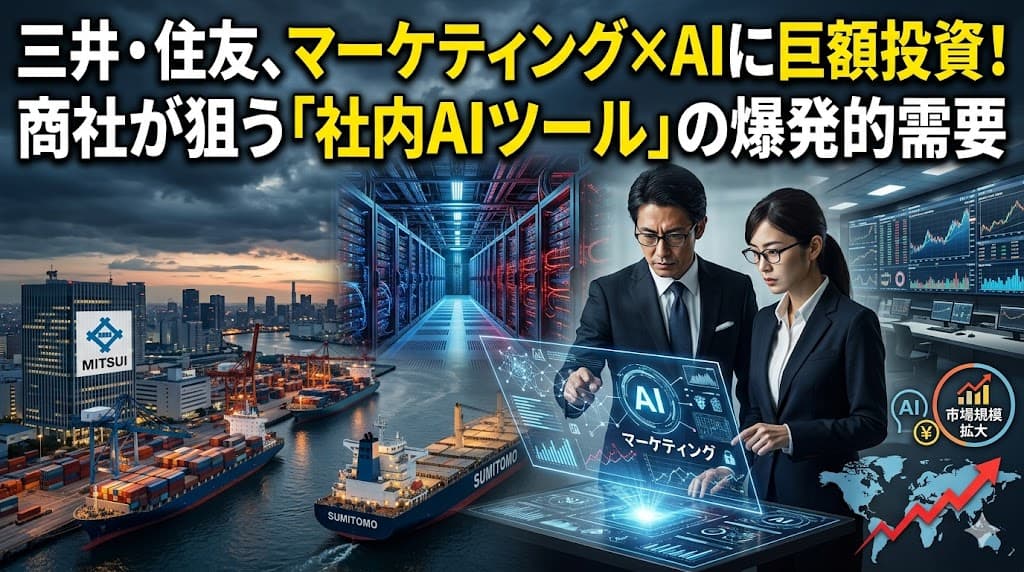
Mitsui & Sumitomo Bet on Marketing × AI: Trading Houses Target In-House AI Tool Demand
三井物産と住友商事のAIマーケティング事業参入を題材に、内製化・差別化・子会社設立など実践的なビジネス英語表現を学べる教材です。
Part 1: 読む → 要約する
Step 1: Pre-Reading — ビジネスの文脈で考える (3 min)
あなたは外資系コンサルティングファームの戦略コンサルタントです。月曜朝のチームミーティングで、日本の総合商社の新規事業動向についてシニアマネージャーから意見を求められました。この記事をもとに、3分以内で論点を整理する必要があります。
Q1: What kinds of businesses do Japanese general trading companies (sogo shosha) typically operate? 総合商社の事業領域の広さについて、知っていることを英語で説明してみましょう。
Q2: Why might large advertisers want to build their own AI marketing tools in-house rather than rely on external vendors? 広告主が自社でAIツールを内製化したい理由を、コスト・データ・スピードの観点から考えてみましょう。
Q3: What advantages do trading companies have when entering a new business area like generative AI services? 商社特有の強み(顧客基盤、業界ネットワーク、資本力など)を踏まえて考えてみましょう。
Step 2: First Reading — 全体を把握する (10 min)
以下の英文は、ニュース記事の事実をもとに作成したビジネスシナリオ文書です。実際の職場でこのような文書を読む場面を想像しながら、英文を読み進めましょう。
INTERNAL BRIEFING MEMO
TO: Marketing Technology Strategy Committee FROM: Akira Tanaka, Director of Competitive Intelligence DATE: May 12, 2026 SUBJECT: Market Entry by Japanese Trading Houses into AI Marketing Services — Strategic Implications and Recommended Response
1. Purpose of this Memo
This briefing outlines a recent development that may affect our positioning in the marketing technology advisory space. Two of Japan's largest general trading companies, Mitsui & Co. and Sumitomo Corporation, have each launched dedicated subsidiaries to provide generative AI support services, with an initial focus on marketing applications. The committee is asked to review the implications and approve a preliminary response plan by the end of this month.
2. Background
General trading houses (sogo shosha) have historically expanded by identifying emerging needs across a broad range of product categories. Their business model depends on reading market trends early and entering sectors where demand is growing. In recent quarters, both Mitsui & Co. and Sumitomo Corporation have identified generative AI implementation support as a high-growth area, particularly for enterprise clients seeking to bring marketing technology capabilities in-house.
3. Key Observations
- Both companies have established standalone subsidiaries rather than handling the business through existing divisions. This signals a long-term commitment rather than an experimental pilot.
- The initial target segment is advertisers that currently outsource campaign analytics, creative production, and audience targeting, and that wish to internalize these functions for cost control and data protection reasons.
- Trading houses are likely to leverage their existing relationships with manufacturers, retailers, and media buyers to acquire clients quickly.
4. Implications for Our Practice
Our mid-market clients may be approached directly by these new entrants within the next six months. Trading houses can bundle AI advisory services with logistics, procurement, and financing arrangements that we cannot match. However, our strength in change management and global benchmarking remains a clear differentiator.
5. Requested Action
Please review and respond with feedback by Friday, May 22. We will convene a working group the following week to finalize our response strategy.
Data sourced from: Nikkei — "三井物産・住友商事、マーケ×AIに挑む 広告主のツール内製化に商機" (May 11, 2026)
Note: The above is an original business scenario created for learning purposes using publicly available facts. Please read the original article at the link above for the full report.
Step 3: Comprehension Check — 内容確認 (5 min)
Q1: Which two Japanese trading companies are mentioned as entering the AI marketing services market? メモの冒頭部分に注目しましょう。
Q2: What organizational structure did both companies use to enter this business? 「standalone subsidiaries」という表現がヒントです。
Q3: Why do advertisers want to bring marketing technology capabilities in-house, according to the memo? コストとデータ保護に関する記述を確認しましょう。
Q4: What competitive advantage do trading houses have over the author's consulting firm? Section 4 の "bundle" に関する記述を読み取りましょう。
Q5: What action is the committee asked to take, and by when? Section 5 の依頼事項と期日を確認しましょう。
Step 4: 30-Second Briefing — 上司に30秒で説明する (10 min)
月曜の朝、エレベーターで上司にばったり会いました。「あの商社のAI参入の話、読んだ?要点だけ30秒で教えて」と言われました。簡潔に、しかし重要な事実を漏らさず説明できるでしょうか。
| 構成要素 | テンプレート |
|---|---|
| ① 何が起きたか | "Two major Japanese trading houses, _______ and _______, have launched _______ to enter the _______ market." |
| ② なぜ重要か | "This matters because trading houses are leveraging _______ to compete with traditional _______." |
| ③ 顧客のニーズ | "Their target clients are advertisers who want to _______ their marketing technology in-house for _______ reasons." |
| ④ 自社への示唆 | "For us, this could mean _______ within the next _______ months." |
| ⑤ 結論・提案 | "I think we should _______ to stay competitive." |
💡 Tip: 元の文章をそのまま暗記するのではなく、自分の言葉で言い換える(paraphrase する)ことで、記憶に残りやすく、応用も効きやすくなります。"establish a subsidiary" を "set up a new company" と言い換えるなど、複数の表現を持っておきましょう。
Part 2: 語彙・表現・発音
1. subsidiary (n.) — 子会社
- Example: Both companies have established standalone subsidiaries rather than handling the business through existing divisions.
- 訳: 両社は既存部門で対応するのではなく、独立した子会社を設立しました。
- 外資系シーン: M&A や事業戦略の議論で頻出。"wholly-owned subsidiary"(完全子会社)、"overseas subsidiary"(海外子会社)といった派生表現もよく使われます。
2. leverage (v.) — 活用する、てこ入れする
- Example: Trading houses are likely to leverage their existing relationships with manufacturers and retailers.
- 訳: 商社は、メーカーや小売業者との既存の関係を活用すると考えられます。
- 外資系シーン: "Let's leverage our existing assets" のように、戦略会議で必ず登場する動詞です。「使う」を上品に言い換える定番表現です。
3. internalize (v.) — 内製化する、社内に取り込む
- Example: Advertisers wish to internalize these functions for cost control and data protection reasons.
- 訳: 広告主は、コスト管理とデータ保護の観点から、これらの機能を内製化したいと考えています。
- 外資系シーン: "in-house" と並んで、業務の内製化議論で使われます。"externalize"(外部委託する)の対義語として覚えると効果的です。
4. bundle (v.) — 抱き合わせて提供する、パッケージ化する
- Example: Trading houses can bundle AI advisory services with logistics and financing arrangements.
- 訳: 商社はAIアドバイザリーサービスを、物流や金融サービスと抱き合わせて提供できます。
- 外資系シーン: SaaS や複合サービスの営業戦略でよく使われます。"bundled pricing"(パッケージ価格)も頻出表現です。
5. differentiator (n.) — 差別化要因
- Example: Our strength in change management remains a clear differentiator.
- 訳: チェンジマネジメントにおける当社の強みは、明確な差別化要因として残っています。
- 外資系シーン: マーケティングや競合分析の場で頻繁に登場。"key differentiator"(重要な差別化要因)の形で覚えるのがおすすめです。
Fill-in-the-blank Exercise
次の英文の空欄に、上記の語彙から最も適切なものを選んで入れましょう(必要に応じて活用形を変更)。
Q1: Our company plans to _______ its data analytics capabilities to reduce dependence on external vendors.
Q2: Speed of delivery is our main _______ in this competitive market.
Q3: The parent company decided to spin off the AI division into a separate _______.
Q4: The sales team will _______ the software license with three years of premium support.
Part 3: 自分の意見を述べる
Discussion Topic A
Do you think Japanese trading houses can succeed in the AI services market, or will they struggle against specialized tech firms? 商社の強み(顧客基盤、資本力)と弱み(技術人材、スピード感)を比較してみましょう。
Discussion Topic B
Should companies build AI tools in-house, or rely on external vendors? Which approach makes more sense for your industry? 自社の業界における機密データの重要性や、IT人材の確保しやすさを踏まえて考えましょう。
Discussion Topic C
What kind of generative AI use case would bring the biggest impact to your current job? 現在の業務で、繰り返し作業や情報整理など、AIで効率化できそうな領域を具体的に挙げてみましょう。
| English | Japanese |
|---|---|
| In my view, the key question is whether... | 私の見方では、重要な問いは〜かどうかです |
| One important consideration is that... | 一つ重要な検討事項は〜という点です |
| I would argue that this approach makes sense because... | 〜という理由でこのアプローチは理にかなっていると主張します |
| On the other hand, there's a risk that... | 一方で、〜というリスクもあります |
| Based on my experience in this industry... | 業界での自分の経験から言うと… |
Part 4: 面接対策 — 外資系で差をつける
Scenario A: Strategy Consulting Firm Interview
Interviewer: "We've seen that Japanese trading companies are entering the AI services market. How would you advise a traditional IT consulting firm to respond to this competitive threat?"
商社の参入による競争環境の変化を整理し、既存コンサルが取るべきポジショニング戦略を、構造立てて答えましょう(例:強みの再定義、ニッチ特化、提携など)。
Scenario B: Marketing Technology Vendor Interview
Interviewer: "Many of our clients are trying to internalize their marketing tools. How would you sell our SaaS platform in this environment?"
内製化トレンドを否定するのではなく、共存・補完するソリューションとして提案する視点が重要です。
Scenario C: Trading Company (Mid-Career) Interview
Interviewer: "Why do you think a trading company is the right place to drive generative AI adoption, compared to a tech startup?"
商社特有の強み(業界横断のネットワーク、ファイナンス機能、長期顧客関係)を、AI事業の文脈で語れるよう準備しましょう。
Common Mistakes (NG Patterns)
NG 1: 抽象的すぎて中身が薄い
- ❌ Bad: "AI is very important and will change everything in business."
- ⭕ Good: "Generative AI is reshaping marketing operations because it allows companies to automate campaign analysis that previously required teams of analysts."
- 解説: "important" や "change everything" のような抽象語だけでは説得力がありません。具体的な業務領域と変化のメカニズムをセットで語りましょう。
NG 2: 暗記した表現の不自然な使用
- ❌ Bad: "I would like to leverage the synergy to maximize the value proposition of our holistic solution."
- ⭕ Good: "I'd use our existing client relationships to introduce the new AI services and grow revenue gradually."
- 解説: バズワードを並べると、かえって中身が伝わりません。自分の言葉でシンプルに説明する方が説得力があります。
NG 3: 質問への直接的な回答を避ける
- ❌ Bad: "Well, there are many factors to consider, and it really depends on the situation..."
- ⭕ Good: "Yes, I believe trading houses have a real advantage here, mainly because of their client networks. Let me explain why."
- 解説: 外資系面接では、まず立場(Yes/No、賛成/反対)を明確にしてから、根拠を述べる「結論先出し」が好まれます。
NG 4: 受け身すぎる表現
- ❌ Bad: "I was told to manage the project, and the goals were achieved."
- ⭕ Good: "I led the project from kickoff to launch, and we achieved a 20% increase in conversion."
- 解説: 主語を "I" にして、能動的に動いた事実を伝えましょう。受動態の多用は、当事者意識が弱い印象を与えます。
活用のコツ(3 Tips)
Tip 1: ニュースを「自社視点」で読み替える習慣をつけましょう。 記事を読んだら必ず「自分の会社・業界にとってこの動きは何を意味するか?」と自問してみましょう。今回の商社のAI参入の話も、自社が広告主・ベンダー・コンサルのどの立場にあるかで示唆が変わります。
Tip 2: 「事実」と「示唆」を分けてメモする訓練をしましょう。 英語ニュースの理解力を上げるには、まず固有名詞・数値などの事実を箇条書きで抽出し、その後に「だから何か(So what?)」を別欄に書く二段階メモが有効です。これは英語の会議でのメモ取りにもそのまま使えます。
Tip 3: 業界トレンドを30秒で説明できる「ストック」を増やしましょう。 外資系の職場では、雑談やエレベータートークで業界動向を聞かれる機会が頻繁にあります。今回の記事のような旬のトピックを、英語で30秒・60秒・3分の3パターンで話せるように準備しておくと、咄嗟の場面で差がつきます。
Bonus: プロナビレッスンでの活用法
レッスン前 (20 min)
Part 1 の Step 1〜3 を自習で完了させましょう。Pre-Reading の質問に対する自分の考えをメモにまとめ、Step 2 の英文を声に出して2回音読します。わからない単語は Part 2 で確認し、Fill-in-the-blank も済ませておきます。理解度チェック (Step 3) で答えに自信がない問題には印をつけておき、レッスン中に講師と確認できるよう準備します。
レッスン中 (25 min)
Step 4 の 30-Second Briefing を講師の前で実演し、フィードバックをもらいましょう。続いて Part 3 のディスカッショントピックから1〜2問を選び、講師と対話形式で意見交換を行います。Part 4 の面接シナリオは1つを選んで模擬面接を実施し、NG パターンに陥っていないかチェックしてもらいましょう。発音や言い回しの自然さも、その場で修正してもらえる絶好の機会です。
レッスン後 (15 min)
レッスン中に指摘された表現や、自分が詰まった箇所をノートにまとめ直しましょう。30-Second Briefing を録音し、自分の発話を聞き返して改善点を確認します。最後に、今回学んだ語彙(subsidiary, leverage, internalize, bundle, differentiator)を使った例文を3つずつ作り、翌週の業務シーンで実際に使えるかを意識して定着を図ります。
PronuNavi では、こうしたビジネス英語学習の進め方について free consultation をご用意しています。学習方法に迷ったら、お気軽にご相談ください。
参考・出典
この記事を書いた人
サイト運営・日本語サポート担当 / AIエンジニア
- ●東京都出身・海外在住13年以上
- ●IT歴36年以上(開発・SEO・AI)
- ●IBM認定 生成AIエンジニア
- ●CEFR B1の英語学習者(今も学習中)
外資系の現場で「英語が話せず評価が伸びない」苦しさを経験し、海外移住後も印刷所で「copy」が通じないような発音の壁に何度もぶつかってきました。今もプロ講師の指導を受けながら学習を続ける一人として、AI時代でも英語で悩む日本人ビジネスパーソンに向けて、現場目線で記事を書いています。日本語でのご相談やお問い合わせも私が担当します。
関連記事
GMO在宅勤務「完全廃止」を英語で説明する|ニュースで学ぶビジネス英語教材
GMOの在宅勤務「完全廃止」ニュースを教材化。英文社内メモの読解、上司への30秒説明、頻出語彙、面接想定問答まで収録し、働き方トレンドを語れるビジネス英語力を鍛えます。無料の英語学習教材です。
2026/7/14
三菱UFJが時価総額首位に|40年ぶりの「金融復権」を英語で語るビジネス英語教材
三菱UFJが時価総額首位、1986年以来40年ぶりの金融復権。このニュースを教材に、市場・金利・株主還元を語るビジネス英語を学習。社内メモ読解、30秒要約、ディスカッション、外資系面接対策まで実践形式で身につく無料教材です。
2026/7/13
Apple対OpenAI訴訟で学ぶビジネス英語|営業秘密と情報管理を英語で語る実践教材
AppleによるOpenAI提訴のニュースを教材化。営業秘密・情報管理をテーマに、社内メモの読解、上司への30秒説明、重要単語、ディスカッション、面接対策まで実践的に学べるビジネス英語学習コンテンツ。外資系で働く日本人ビジネスパーソンの英語力を鍛えます。
2026/7/12
三菱自動車×東大発Highlandersのヒト型ロボット量産提携で学ぶビジネス英語教材
三菱自動車と東大発Highlandersのヒト型ロボット量産提携ニュースで学ぶビジネス英語教材。mass productionなど頻出語彙、30秒ブリーフィング、外資系面接対策まで実践的に学べる英語学習コンテンツです。
2026/7/11
OpenAI「ChatGPT Work」で学ぶビジネス英語|AIエージェント最新ニュース教材
OpenAIの「ChatGPT Work」とGPT-5.6を題材にしたビジネス英語学習教材。社内メモ読解や30秒ブリーフィング、面接対策を通じて、AI時代の職場で使える実践英語を身につけます。
2026/7/10
Grok 4.5で学ぶビジネス英語|AI最新ニュースで鍛える読解と要約力
話題のAIモデル「Grok 4.5」の英語ニュースを教材化。社内ブリーフィングメモの読解、要約、面接対策まで。最新テックニュースで実践的なビジネス英語を学びたい方へ。
2026/7/9