
三菱自動車×東大発Highlandersのヒト型ロボット量産提携で学ぶビジネス英語教材
三菱自動車と東大発Highlandersのヒト型ロボット量産提携ニュースで学ぶビジネス英語教材。mass productionなど頻出語彙、30秒ブリーフィング、外資系面接対策まで実践的に学べる英語学習コンテンツです。

AIエンジニア / IT歴36年以上・海外在住13年以上のCEFR B1英語学習者
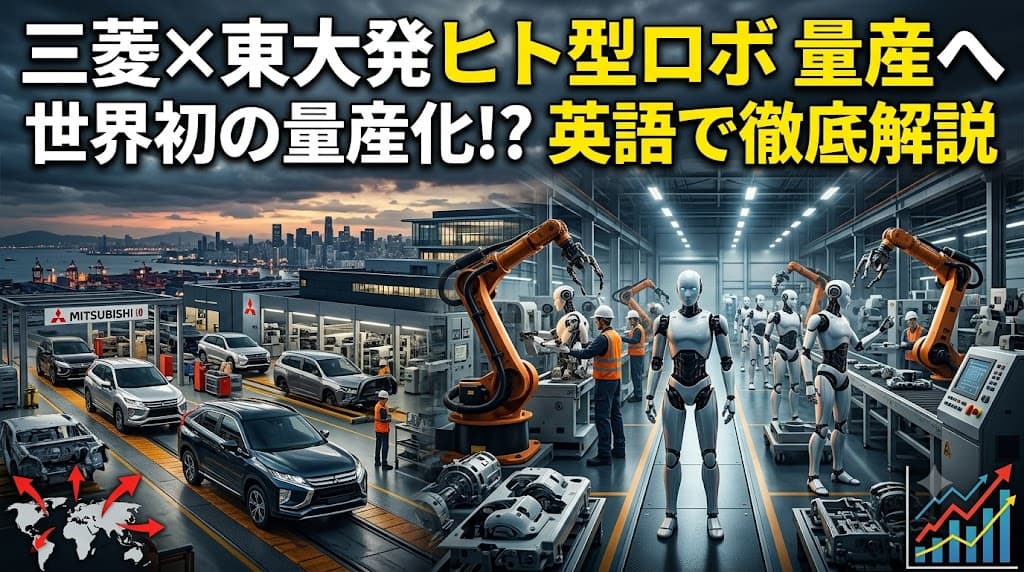
Japan's First Automaker–Robotics Alliance: Mitsubishi Motors and Highlanders Target 1,000 Humanoid Robots a Month
月産1000台を目指す国産ヒューマノイドロボットの提携ニュースを題材に、社内メモの読解から上司への30秒英語ブリーフィング、外資系面接対策までを実践的に鍛えられる教材です。
Part 1: 読む → 要約する
Step 1: Pre-Reading — ビジネスの文脈で考える (3 min)
Scene: あなたは外資系メーカーの日本法人に勤務しています。月曜朝のチームミーティングで、グローバル本社から来ているマネージャーが「今週、日本市場で注目すべき動きはあった?」と全員に問いかけました。あなたは日本の製造業に関するニュースを共有することになりました。
Q1. Why might a car manufacturer want to move into the humanoid robot business? (自動車メーカーが持っている「量産の技術」を思い浮かべてみましょう。)
Q2. What kind of work in a factory is difficult to automate with traditional machines? (従来の産業用ロボットが苦手とする作業は何でしょうか。手作業や不整地での作業を考えてみてください。)
Q3. Why do some countries want robots to be developed and produced domestically? (経済安全保障、サプライチェーン、技術流出などのキーワードで考えてみましょう。)
Step 2: First Reading — 全体を把握する (10 min)
以下の英文は、ニュース記事の事実をもとに作成したビジネスシナリオ文書です。実際の職場でこのような文書を読む場面を想像しながら、英文を読み進めましょう。
INTERNAL BRIEFING MEMO
To: Regional Strategy Committee, APAC From: Kenji Sato, Manager, Competitive Intelligence Team Date: July 10, 2026 Subject: Update on Japan's Humanoid Robot Market — Action Required by July 24
1. Purpose This memo summarizes a development that may affect our automation roadmap in Japan and asks each department to submit an initial response by July 24.
2. What happened On July 9, Mitsubishi Motors and Highlanders, a startup founded out of the University of Tokyo, signed a basic agreement to jointly develop humanoid robots and bring them to mass production. According to both companies, this is the first case in which a carmaker and a robot developer have formed a partnership with mass production as the stated goal.
3. Key facts for our planning
- Volume target: 1,000 units per month, with the production system to be in place in the second half of 2027.
- Site: Mitsubishi Motors' Kyoto Plant, which currently produces engines. Idle buildings, existing assembly jigs and logistics lines will be repurposed to keep initial investment low and to start production early.
- Technology: Highlanders supplies its fourth-generation humanoid robot "N" and its AI foundation model "Kepler v1.0", both developed in-house. The robots run on "physical AI", meaning the AI controls the machine autonomously.
- What the carmaker brings: mass-production design, quality assurance, durability and safety design, integrated mechanical-electrical control, and factory operations know-how.
- Supply chain: Core components such as motors will be sourced or produced domestically, with several manufacturing partners supporting the 1,000-unit target.
4. Why this matters Japan is losing roughly 900,000 workers a year in manufacturing and social infrastructure because of population decline. Conventional factory automation cannot cover manual tasks or work on uneven ground. Firms in the United States and China currently lead this field, and the partners argue that keeping R&D, manufacturing and deployment inside Japan is also an economic security issue.
5. Requested action
- Operations: identify three processes on our lines that humanoid robots could realistically take over by 2028.
- Procurement: assess the risk to our current automation vendors if domestic supply chains tighten.
- HR: draft a short position on how our people would work alongside such robots.
Please send your comments to me by July 24. I will consolidate them for the August committee meeting.
Data sourced from: Seizo Trend(ビジネス+IT) — "三菱自動車と東大発Highlandersが協業、国産人型ロボットの月産1000台体制へ" (2026/07/10)
Note: The above is an original business scenario created for learning purposes using publicly available facts. Please read the original article at the link above for the full report.
Step 3: Comprehension Check — 内容確認 (5 min)
Q1. What did Mitsubishi Motors and Highlanders agree to do together? (合意の内容を2点、動詞を使って説明しましょう。)
Q2. How many robots do they aim to produce per month, and by when? (数字と時期をセットで答えます。)
Q3. Why was the Kyoto Plant chosen, and how will costs be kept down? (「転用(repurpose)」がキーワードです。)
Q4. What does each partner contribute to the project? (技術側とものづくり側、それぞれの強みを対比させましょう。)
Q5. What background makes humanoid robots necessary in Japan, according to the memo? (労働力の減少と、従来の自動化の限界の2点を挙げましょう。)
Step 4: 30-Second Briefing — 上司に30秒で説明する (10 min)
Scene: エレベーターで外国人上司と一緒になりました。「I heard something about Mitsubishi and robots. What's that about?」と聞かれました。降りるまで約30秒。要点だけを、結論から伝えます。
| 構成 | テンプレート | 記入欄 |
|---|---|---|
| ① 結論(What) | "Mitsubishi Motors has agreed to ____________ with a University of Tokyo startup called Highlanders." | |
| ② 数字(How big) | "They aim to produce ____________ units per month by ____________." | |
| ③ 方法(How) | "They will use ____________ and repurpose ____________ to keep costs down." | |
| ④ 意味(So what) | "For us, this means ____________." | |
| ⑤ 次の一歩(Next) | "I'll ____________ and get back to you by ____________." |
Tip: 記事の言葉をそのまま暗記するのではなく、自分の言葉で言い換える(paraphrase)練習をしましょう。例えば "mass production" が出てこなければ "make them in large numbers" と言えば十分に伝わります。上司が求めているのは正確な単語ではなく、判断に使える要点です。
Part 2: 語彙・表現・発音
1. mass production (n.) — 量産、大量生産
Example: The two companies signed an agreement covering joint development and mass production. (両社は共同開発と量産に関する合意書を締結しました。)
外資系シーン: 製造業の会議で「試作段階」と「量産段階」を区別する場面で必ず登場します。動詞形は "mass-produce"(量産する)です。"Are we ready for mass production?" は「量産の準備は整っているか」という定番の確認表現です。
2. repurpose (v.) — 転用する、別の目的に作り変える
Example: The company will repurpose idle buildings and existing logistics lines to reduce initial investment. (同社は遊休建屋と既存の物流ラインを転用し、初期投資を抑えます。)
外資系シーン: コスト削減の提案で非常に使いやすい単語です。設備だけでなく、資料やデータにも使えます。"Let's repurpose the Q1 deck for this client." のように言えば「一から作らない」という判断を短く伝えられます。
3. supply chain (n.) — サプライチェーン、供給網
Example: They plan to build a strong domestic supply chain with several manufacturing partners. (複数の製造パートナーと連携し、強固な国内サプライチェーンを構築する計画です。)
外資系シーン: 調達・生産の議論では日常語です。"supply chain risk"(供給網リスク)、"supply chain disruption"(供給網の混乱)はセットで覚えておくと、リスク説明の場面で即戦力になります。
4. labor shortage (n.) — 労働力不足
Example: Japan's labor shortage is one of the main reasons behind the push for humanoid robots. (日本の労働力不足が、ヒューマノイドロボット推進の主な理由の一つです。)
外資系シーン: 海外の同僚に日本市場を説明するとき、最も頻繁に必要になる表現の一つです。"an aging population"(高齢化する人口)や "population decline"(人口減少)と組み合わせると、背景説明が一気に明確になります。
5. vertical integration (n.) — 垂直統合
Example: Highlanders' CEO described a vertically integrated model covering AI research, mass-production technology and real-world testing. (HighlandersのCEOは、AI研究・量産技術・実証現場を一貫して抱える垂直統合型モデルについて説明しました。)
外資系シーン: 経営戦略の議論で使われる用語です。形容詞形 "vertically integrated" のほうが会話では頻出します。反対の概念は外部委託(outsourcing)で、"Should we integrate this vertically or outsource it?" は投資判断の典型的な問いです。
Fill-in-the-blank Exercise
次の空欄に、Part 2 の語彙から適切なものを選んで入れてください(必要に応じて形を変えてください)。
Q1. The prototype works well, but we are still two years away from ____________.
Q2. Instead of buying new equipment, we decided to ____________ the machines from the old line.
Q3. A serious ____________ in the region is forcing factories to automate faster than planned.
Q4. Because the company controls research, manufacturing and sales, its business model is highly ____________ ____________.
Part 3: 自分の意見を述べる
Discussion Topic A
Q. Do you think humanoid robots are a realistic solution to labor shortages, or is it mainly a way to attract investment? (「現実的な解決策」と「話題づくり」のどちらに近いか、立場を決めてから理由を2つ挙げましょう。ロボットが得意な作業・苦手な作業を具体的に想像すると説得力が増します。)
Discussion Topic B
Q. Mitsubishi Motors will use an existing engine plant instead of building a new factory. Is this a smart decision or a risky compromise? (初期投資の抑制というメリットと、既存設備の制約というデメリットを比較しましょう。自社で似た判断をした経験があれば、それを例に使えます。)
Discussion Topic C
Q. Should countries try to keep robot development and production entirely domestic, even if it costs more? (経済安全保障と、コスト・スピードのトレードオフです。「賛成だが条件付き」という答え方も有効です。)
Useful Phrases
| English | Japanese |
|---|---|
| I see both sides, but on balance I would say... | どちらの側面もわかりますが、総合的に見ると私は…と考えます |
| It depends on how quickly they can scale up. | どれだけ早く規模を拡大できるかによります |
| The bigger question for me is whether... | 私にとってより重要な問いは、…かどうかです |
| That may be true in theory, but in practice... | 理論上はそうかもしれませんが、実際には… |
| Let me give you a concrete example from my own work. | 自分の仕事から具体例を挙げさせてください |
Part 4: 面接対策 — 外資系で差をつける
Scenario A — 業界理解を問う質問
Interviewer: "You mentioned you follow the manufacturing sector. Tell me about a recent development that you found significant, and explain why." (このニュースを使って答える練習をしましょう。事実の羅列で終わらず、「なぜ重要か」を自分の視点で述べることが評価されます。)
Scenario B — 変化への適応力を問う質問
Interviewer: "If robots took over part of your team's work within two years, how would you prepare your team?" (人員削減の話に逃げず、「人が担うべき仕事は何か」を再定義する視点を示しましょう。)
Scenario C — 判断力を問う質問
Interviewer: "Your company can either build a new automated plant or repurpose an existing one at lower cost. Which would you recommend, and what information would you need first?" (結論を先に述べ、その後に「必要な情報」を3点に絞って挙げると構成が明確になります。)
4 Common Mistakes (NG Patterns)
NG 1: 事実の暗唱で終わってしまう
- Bad: "Mitsubishi Motors and Highlanders signed an agreement on July 9. They will produce 1,000 units per month."
- Good: "Mitsubishi Motors and Highlanders signed an agreement in July. What struck me is that a carmaker is applying mass-production know-how to robots — that could change who leads this market."
記事の内容を正確に言えても、それだけでは評価されません。「私はこう見ている」という一文を必ず添えてください。
NG 2: 断定を避けすぎて主張が消える
- Bad: "Maybe it is good, maybe it is not. It is difficult to say. It depends."
- Good: "I'm cautiously positive. The volume target is ambitious, but reusing an existing plant lowers the risk."
謙虚さは美徳ですが、面接では立場のない発言は「判断できない人」と受け取られます。留保をつけながらでも、結論を先に出しましょう。
NG 3: 抽象的な言葉だけで具体例がない
- Bad: "Robots are very important for the future of manufacturing. Technology is changing everything."
- Good: "In my last role, we couldn't automate final inspection because it required judgment by hand. That is exactly the gap humanoid robots are aiming at."
一般論は誰でも言えます。自分の経験と結びつけた瞬間に、あなたの回答になります。
NG 4: 質問に答える前に前置きが長い
- Bad: "Well, that is a very good question, and there are many aspects to consider, and before I answer I should explain the background of the Japanese market..."
- Good: "Yes — I'd repurpose the existing plant. Here's why, in three points."
結論を先に述べる(conclusion first)姿勢は、それ自体が「英語で仕事ができる人」というシグナルになります。
活用のコツ(3 Tips)
Tip 1: 自社の工程を1つ選び、「ロボットに置き換えられるか」を英語で説明してみましょう。 記事を読んだだけでは記憶に残りませんが、自分の職場の具体的な工程(検査、搬送、組立など)に当てはめて英語で3文にまとめると、語彙が「使える知識」に変わります。
Tip 2: 数字を必ずセットで覚え、会議で引用できる状態にしておきましょう。 「月産1000台」「2027年後半」「年間約90万人の労働力減少」の3つは、日本市場を海外の同僚に説明する際にそのまま使える強力な材料です。数字を1つ添えるだけで、あなたの発言の信頼度は大きく上がります。
Tip 3: 同じニュースを「賛成」「反対」の両方の立場で1分ずつ話す練習をしましょう。 外資系の議論では、自分と異なる立場を先回りして理解している人が信頼されます。両方を話せるようになると、実際の会議で相手の反論にも動じずに対応できます。
Bonus: プロナビレッスンでの活用法
レッスン前(20min) Part 1 の Step 1〜3 に一人で取り組みます。Step 2 の英文は最低2回読み、わからない単語は文脈から推測してから辞書を引きましょう。Part 2 の語彙5つは、例文ごと声に出して読み、Step 4 のブリーフィング用テンプレートを自分の言葉で埋めておきます。
レッスン中(25min) 最初にコーチへ30秒ブリーフィングを実演し、発音・強勢・間の取り方についてフィードバックを受けます。その後、Part 3 のディスカッショントピックから1つを選び、コーチと議論します。最後に Part 4 の模擬面接シナリオを1つ実施し、NGパターンに陥っていないかをその場で確認します。
レッスン後(15min) レッスン中に指摘された発音・表現を3つに絞って書き出し、Step 4 のブリーフィングをもう一度録音して聞き返します。Part 2 の語彙は、翌週の実務メールや会議で最低1回使うことを目標に設定しましょう。学んだ表現は「使った瞬間」に定着します。
英語コーチングについてご相談がある方は、無料相談をご利用ください。お気軽にお問い合わせください。
参考・出典
この記事を書いた人
サイト運営・日本語サポート担当 / AIエンジニア
- ●東京都出身・海外在住13年以上
- ●IT歴36年以上(開発・SEO・AI)
- ●IBM認定 生成AIエンジニア
- ●CEFR B1の英語学習者(今も学習中)
外資系の現場で「英語が話せず評価が伸びない」苦しさを経験し、海外移住後も印刷所で「copy」が通じないような発音の壁に何度もぶつかってきました。今もプロ講師の指導を受けながら学習を続ける一人として、AI時代でも英語で悩む日本人ビジネスパーソンに向けて、現場目線で記事を書いています。日本語でのご相談やお問い合わせも私が担当します。
関連記事
GMO在宅勤務「完全廃止」を英語で説明する|ニュースで学ぶビジネス英語教材
GMOの在宅勤務「完全廃止」ニュースを教材化。英文社内メモの読解、上司への30秒説明、頻出語彙、面接想定問答まで収録し、働き方トレンドを語れるビジネス英語力を鍛えます。無料の英語学習教材です。
2026/7/14

三菱UFJが時価総額首位に|40年ぶりの「金融復権」を英語で語るビジネス英語教材
三菱UFJが時価総額首位、1986年以来40年ぶりの金融復権。このニュースを教材に、市場・金利・株主還元を語るビジネス英語を学習。社内メモ読解、30秒要約、ディスカッション、外資系面接対策まで実践形式で身につく無料教材です。
2026/7/13
Apple対OpenAI訴訟で学ぶビジネス英語|営業秘密と情報管理を英語で語る実践教材
AppleによるOpenAI提訴のニュースを教材化。営業秘密・情報管理をテーマに、社内メモの読解、上司への30秒説明、重要単語、ディスカッション、面接対策まで実践的に学べるビジネス英語学習コンテンツ。外資系で働く日本人ビジネスパーソンの英語力を鍛えます。
2026/7/12
OpenAI「ChatGPT Work」で学ぶビジネス英語|AIエージェント最新ニュース教材
OpenAIの「ChatGPT Work」とGPT-5.6を題材にしたビジネス英語学習教材。社内メモ読解や30秒ブリーフィング、面接対策を通じて、AI時代の職場で使える実践英語を身につけます。
2026/7/10
Grok 4.5で学ぶビジネス英語|AI最新ニュースで鍛える読解と要約力
話題のAIモデル「Grok 4.5」の英語ニュースを教材化。社内ブリーフィングメモの読解、要約、面接対策まで。最新テックニュースで実践的なビジネス英語を学びたい方へ。
2026/7/9
マッキンゼーに学ぶAI時代の必須スキル|ニュースで学ぶビジネス英語教材
マッキンゼーのAI活用と「人間に残るスキル」を題材にしたビジネス英語教材。社内メモ読解・要約・ディスカッション・面接対策まで、実務で使える英語学習をニュースで実践できます。
2026/7/8