他人の知能を見抜く力|外資系で差がつくビジネス英語学習教材
知能の高い人ほど他人を正確に評価できるという最新研究を題材に、採用・評価面談で使えるビジネス英語を実践的に学べる学習教材。語彙・要約・面接対策まで網羅。

AIエンジニア / IT歴36年以上・海外在住13年以上のCEFR B1英語学習者
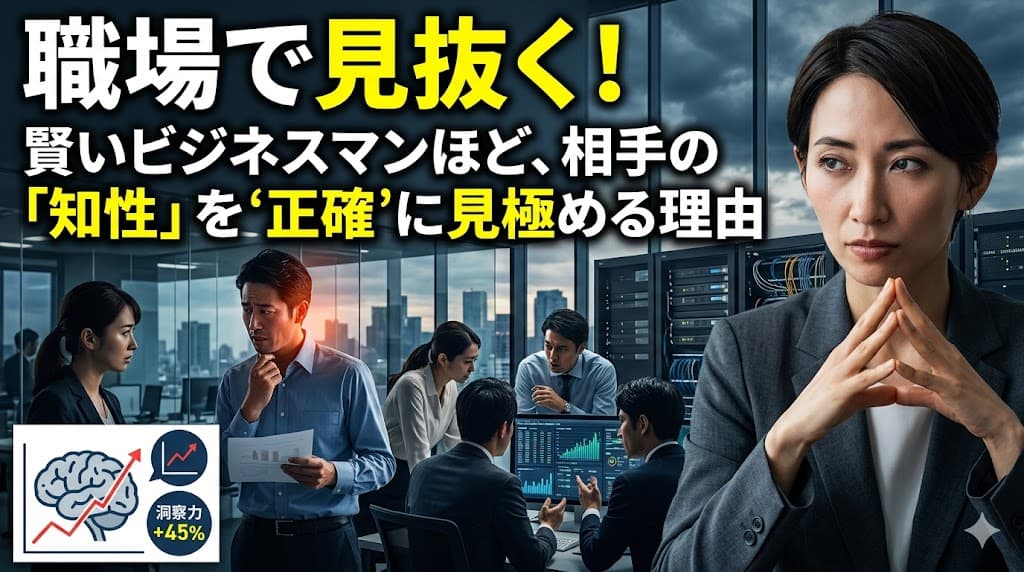
Reading People at Work: Why Smart Professionals Judge Others' Intelligence More Accurately
「人を見る目」は鍛えられるのか。最新研究をもとに、採用面接や評価面談で使える実践的なビジネス英語を学べる教材です。
Part 1: 読む → 要約する
Step 1: Pre-Reading — ビジネスの文脈で考える (3 min)
あなたは外資系企業のHRビジネスパートナーです。月曜の朝のチームミーティングで、新しい採用面接プロセスについて議論しています。マネージャーの一人が「短い面接で候補者の能力を正しく判断するのは難しい」と発言しました。あなたはその週末に読んだ研究記事を共有しようとしています。
Q1. When you meet a new colleague for the first time, what cues do you use to judge how capable they are? (初対面の同僚を判断するとき、どんな手がかりを使っていますか?話し方、語彙、態度などを考えてみましょう)
Q2. Do you think a 1-minute video is enough to evaluate someone's intelligence? Why or why not? (1分間の映像で人の知能を評価できると思いますか?理由も考えてみましょう)
Q3. In your workplace, who do you think is the best at "reading" other people's abilities accurately? (職場で他人の能力を最も正確に「読み取る」のが上手いのは誰だと思いますか?その人の特徴は?)
Step 2: First Reading — 全体を把握する (10 min)
以下の英文は、ニュース記事の事実をもとに作成したビジネスシナリオ文書です。実際の職場でこのような文書を読む場面を想像しながら、英文を読み進めましょう。
INTERNAL BRIEFING MEMO
To: Talent Acquisition Team, APAC Region From: Sarah Tanaka, Director of People Analytics Date: May 4, 2026 Subject: Update on Interviewer Calibration Initiative — Action Required by May 22
1. Background
As part of our ongoing effort to improve hiring quality, the People Analytics team has reviewed recent academic research relevant to interviewer judgment. A study led by Christoph Heine at Witten/Herdecke University in Germany, published in Intelligence (a journal hosted on ScienceDirect), has produced findings that directly affect how we should structure our interview panels.
2. Key Findings
The study examined 198 participants — 72% of whom were university students, 140 of whom were female, with an average age of 29. Each participant watched fifty 1-minute videos of target individuals whose intelligence had been measured in advance. The targets read weather forecasts aloud, described enjoyable recent experiences, explained the meaning of the word "symmetry," and performed short role-plays. After each video, participants rated the target's intelligence on a five-point scale.
Three points are most relevant to our work:
- The ability to judge another person's intelligence varied significantly across individuals.
- Participants who themselves scored higher on cognitive tests judged the targets more accurately.
- High emotional recognition skills and high life satisfaction were also linked to more accurate judgments.
Notably, the researchers expected gender, empathy, openness, and social curiosity to predict accuracy — but found no clear relationship.
3. Implications for Our Hiring Process
These findings suggest that not every interviewer is equally suited to assess candidate capability from short interactions. Accuracy appears to depend on the interviewer's own cognitive and emotional skills, and judgments are most reliable when based on observable behavioral cues — clarity of speech, content, and vocabulary.
4. Action Items
- Review the attached interviewer assessment results by May 15.
- Nominate two senior team members for our new "calibration lead" role by May 22.
- Pilot the revised panel structure during the June hiring round.
Please reply to this email with any questions. A follow-up call will be scheduled for May 18.
Data sourced from: GIGAZINE — "知能が高い人は「他人の知能」もより正しく判断できるとの研究結果" (May 2, 2026)
Note: The above is an original business scenario created for learning purposes using publicly available facts. Please read the original article at the link above for the full report.
関連: 外資系面接で即採用される英語フレーズと欧米文化の伝え方|日本人ビジネスパーソンの面接対策 で詳しく解説しています。
Step 3: Comprehension Check — 内容確認 (5 min)
Q1. Who is the sender of this memo, and what is her role? (差出人は誰で、どのような役職についていますか?)
Q2. How many participants took part in the study, and what was their average age? (実験の参加者は何人で、平均年齢は何歳でしたか?)
Q3. What three types of activities did the targets perform in the videos? (動画の中で対象者は具体的にどんな行動をしましたか?3つ挙げましょう)
Q4. According to the memo, which factors did NOT show a clear relationship with judgment accuracy? (判断の正確性と明確な関連が見られなかった要因は何でしたか?)
Q5. What two deadlines does the memo set, and what action is required for each? (メモが設定している2つの締切と、それぞれで求められているアクションは何ですか?)
関連: 外資系で評価される英語・されない英語の違い|会議で伝わるビジネス英語コーチング で詳しく解説しています。
Step 4: 30-Second Briefing — 上司に30秒で説明する (10 min)
月曜の朝、エレベーターで部長と一緒になりました。「あのメモ読んだよ。要するに何が言いたいの?」と聞かれました。階数到着まであと30秒。あなたはどう答えますか?
| Framework | Template | あなたの回答 |
|---|---|---|
| ① Topic (1文) | "The memo is about ___________." | |
| ② Key finding (1〜2文) | "A recent study found that ___________." | |
| ③ Why it matters (1文) | "This is important for us because ___________." | |
| ④ Next step (1文) | "We need to ___________ by ___________." |
💡 Tip: 元の英文の表現をそのまま暗記するのではなく、自分の言葉で言い換える(パラフレーズする)練習をしましょう。例えば "judged the targets more accurately" は "were better at guessing how smart others are" のように、シンプルな言葉に置き換えると、口頭でスムーズに話せます。
Part 2: 語彙・表現・発音
1. assess (v.) — 評価する、査定する
- Example: It is difficult to assess a candidate's true ability in a single interview.
- 訳: たった1回の面接で候補者の真の能力を評価するのは難しいです。
- 外資系シーン: パフォーマンスレビュー、リスク評価、候補者評価など、客観的な判断を伴う場面で頻出します。"evaluate" よりもややフォーマルな響きがあります。
2. cue (n.) — 手がかり、合図
- Example: Skilled interviewers pick up on subtle behavioral cues during conversations.
- 訳: 優秀な面接官は会話中の微妙な行動上の手がかりを察知します。
- 外資系シーン: 心理学・営業・コーチングの場面で頻出。"verbal cues"(言語的手がかり)、"non-verbal cues"(非言語的手がかり)はセットで覚えましょう。
3. variation (n.) — ばらつき、個人差
- Example: There is significant variation in how managers judge team members' potential.
- 訳: マネージャーがチームメンバーの可能性を判断する方法には大きなばらつきがあります。
- 外資系シーン: データ分析、品質管理、HR分析の場面で頻出。"individual variation"(個人差)、"variation across teams"(チーム間のばらつき)などの表現で使います。
4. implication (n.) — 影響、意味するところ、示唆
- Example: What are the implications of these findings for our hiring strategy?
- 訳: これらの結果は、私たちの採用戦略にどのような影響を与えますか?
- 外資系シーン: 経営会議、戦略討議、レポート作成で必須の単語。"business implications"(ビジネス上の示唆)は決まり文句です。
5. calibration (n.) — 調整、すり合わせ、較正
- Example: We hold a calibration meeting every quarter to align our evaluation standards.
- 訳: 評価基準を揃えるため、四半期ごとに調整ミーティングを行っています。
- 外資系シーン: 人事評価で「キャリブレーション」はカタカナでもよく使われますが、英語圏では機械や測定の「較正」の意味でも頻出。文脈で意味を判断しましょう。
Fill-in-the-Blank Exercise
以下の文の空欄に、上記の語彙から適切な単語を選んで入れましょう(形を変える必要がある場合があります)。
Q1. The board needs to understand the financial _____________ of this acquisition before making a decision.
Q2. We use AI tools to _____________ each application based on the same set of criteria.
Q3. A good salesperson can read a customer's emotional _____________ within the first few minutes.
Q4. There is too much _____________ between offices in how performance is rated, so we need a global _____________ session.
解答: Q1. implications / Q2. assess / Q3. cues / Q4. variation, calibration
Part 3: 自分の意見を述べる
Discussion Topic A
Should companies train all interviewers, or only select the most "naturally accurate" judges to interview candidates? (全員に面接トレーニングをすべきか、それとも「自然に判断が正確な人」だけを面接官に選ぶべきか?コスト・公平性・効率の観点から考えてみましょう)
Discussion Topic B
The study suggests that people with high life satisfaction judge others more accurately. Do you agree this could apply to the workplace? (人生の満足度が高い人ほど他人を正確に判断できるという結果は、職場にも当てはまると思いますか?自分の経験と照らして考えてみましょう)
Discussion Topic C
If AI tools can analyze speech and vocabulary objectively, should they replace human interviewers entirely? (AIが話し方や語彙を客観的に分析できるなら、面接を完全にAIに任せるべきだと思いますか?人間の面接官の価値はどこにありますか?)
Useful Phrases
| English | Japanese |
|---|---|
| In my experience, ... | 私の経験では… |
| I see your point, but ... | おっしゃることは分かりますが… |
| It depends on the context. For example, ... | 文脈によります。例えば… |
| There's a trade-off between A and B. | AとBにはトレードオフがあります。 |
| I'd push back on that slightly. | その点は少し異論があります。 |
Part 4: 面接対策 — 外資系で差をつける
Mock Interview Scenario A
Interviewer: "Tell me about a time when you misjudged a colleague's ability. What did you learn?" (同僚の能力を見誤った経験について話してください。そこから何を学びましたか?)
Mock Interview Scenario B
Interviewer: "How do you build an accurate picture of someone's skills in a short meeting?" (短い打ち合わせで相手のスキルを正確に把握するために、あなたはどう工夫していますか?)
Mock Interview Scenario C
Interviewer: "Our team needs to improve hiring decisions. If you joined us, what would you do in your first 90 days?" (私たちのチームは採用の質を上げる必要があります。入社したら最初の90日で何をしますか?)
Common Mistakes (NG Patterns)
❌ NG 1:
- Bad: "I am very good at judging people. I always know."
- Good: "I try to base my judgments on specific behaviors I observe — for example, how someone explains a complex idea."
- 解説: 「私は人を見る目があります」と言い切る表現は、根拠のない自信に聞こえます。具体的な行動・観察ポイントに落とし込むと、説得力が増します。
❌ NG 2:
- Bad: "The article says intelligent people judge others better."
- Good: "A recent study suggests that cognitive ability correlates with the accuracy of social judgment."
- 解説: "The article says..." は学校英語的でカジュアルすぎます。"A study suggests..." "Research indicates..." など、ビジネス英語らしいフレーズを使いましょう。
❌ NG 3:
- Bad: "I think... ah... maybe... it depends..."
- Good: "That's a great question. My initial thought is that it depends on the role, but let me give you a concrete example."
- 解説: 沈黙や曖昧な相槌は自信のなさに見えます。一呼吸置く時のフレーズを準備しておくと、考える時間も稼げて自然に聞こえます。
❌ NG 4:
- Bad: "I will assess the team and improve everything."
- Good: "In my first 30 days, I'd focus on listening and gathering data. From day 31 to 60, I'd identify two or three priority areas. By day 90, I'd present a concrete plan."
- 解説: 抽象的な意気込みではなく、時間軸とアクションを具体的に区切って話すと、計画性と実行力をアピールできます。
活用のコツ(3 Tips)
1. 自分の判断バイアスをチェックする習慣をつけましょう。 記事は「知能の高い人ほど他人を正確に評価できる」と示唆していますが、逆に言えば、自分の評価が間違っている可能性も常にあります。週に一度、最近下した人事的判断(メンバーの貢献度評価、候補者評価など)を振り返り、感情ではなく具体的な行動に基づいているか確認しましょう。
2. 「行動上の手がかり」を意識的に観察しましょう。 研究では、話し方の明瞭さ・内容・語彙が判断材料になっていました。次回の英語ミーティングでは、誰が要点を簡潔に話しているか、誰が具体例で説明しているかを意識して観察してみてください。観察力を磨くことが、自分の表現力を上げる近道になります。
3. 短時間で自分の能力を伝える「30秒スクリプト」を準備しましょう。 逆の立場で考えると、相手はあなたを短時間で評価しています。エレベーターピッチ、自己紹介、面接の冒頭など、30秒以内に「専門性・実績・価値」を簡潔に伝えるスクリプトを英語で用意し、声に出して練習しておきましょう。
Bonus: プロナビレッスンでの活用法
📚 レッスン前 (20 min)
- 記事のPart 1 Step 1の3つの問いについて、自分なりの答えを英語でメモしておきましょう(フルセンテンスでなくキーワードでOK)。
- Step 2の英文を1回通読し、分からない単語に印を付けます。意味は調べず、文脈から推測することを優先してください。
- Part 2の語彙5つを音読し、例文を1回ずつ自分の声で発音しておきましょう。
🎯 レッスン中 (25 min)
- 最初の5分で、コーチに記事の要点を英語で30秒で説明してみましょう(Step 4のフレームワーク使用)。
- 次の10分で、Part 3のディスカッショントピックから1つ選び、コーチと意見交換します。Useful Phrasesを意識的に使ってみてください。
- 残り10分で、Part 4の模擬面接シナリオから1つ選び、本番さながらに回答練習。NGパターンに陥っていないかコーチからフィードバックをもらいましょう。
✍️ レッスン後 (15 min)
- レッスン中に指摘された自分の弱点(発音・文法・表現選択など)を1〜3項目に絞ってメモします。
- Part 2のFill-in-the-Blank問題を解き、5つの語彙を使った自分独自の例文を1つずつ作りましょう。
- 1週間以内に、レッスンで練習した30秒ブリーフィングを実際の職場や勉強会で使ってみてください。アウトプットしてこそ定着します。
参考・出典
この記事を書いた人
サイト運営・日本語サポート担当 / AIエンジニア
- ●東京都出身・海外在住13年以上
- ●IT歴36年以上(開発・SEO・AI)
- ●IBM認定 生成AIエンジニア
- ●CEFR B1の英語学習者(今も学習中)
外資系の現場で「英語が話せず評価が伸びない」苦しさを経験し、海外移住後も印刷所で「copy」が通じないような発音の壁に何度もぶつかってきました。今もプロ講師の指導を受けながら学習を続ける一人として、AI時代でも英語で悩む日本人ビジネスパーソンに向けて、現場目線で記事を書いています。日本語でのご相談やお問い合わせも私が担当します。
関連記事

GMO在宅勤務「完全廃止」を英語で説明する|ニュースで学ぶビジネス英語教材
GMOの在宅勤務「完全廃止」ニュースを教材化。英文社内メモの読解、上司への30秒説明、頻出語彙、面接想定問答まで収録し、働き方トレンドを語れるビジネス英語力を鍛えます。無料の英語学習教材です。
2026/7/14
三菱UFJが時価総額首位に|40年ぶりの「金融復権」を英語で語るビジネス英語教材
三菱UFJが時価総額首位、1986年以来40年ぶりの金融復権。このニュースを教材に、市場・金利・株主還元を語るビジネス英語を学習。社内メモ読解、30秒要約、ディスカッション、外資系面接対策まで実践形式で身につく無料教材です。
2026/7/13

Apple対OpenAI訴訟で学ぶビジネス英語|営業秘密と情報管理を英語で語る実践教材
AppleによるOpenAI提訴のニュースを教材化。営業秘密・情報管理をテーマに、社内メモの読解、上司への30秒説明、重要単語、ディスカッション、面接対策まで実践的に学べるビジネス英語学習コンテンツ。外資系で働く日本人ビジネスパーソンの英語力を鍛えます。
2026/7/12
三菱自動車×東大発Highlandersのヒト型ロボット量産提携で学ぶビジネス英語教材
三菱自動車と東大発Highlandersのヒト型ロボット量産提携ニュースで学ぶビジネス英語教材。mass productionなど頻出語彙、30秒ブリーフィング、外資系面接対策まで実践的に学べる英語学習コンテンツです。
2026/7/11
OpenAI「ChatGPT Work」で学ぶビジネス英語|AIエージェント最新ニュース教材
OpenAIの「ChatGPT Work」とGPT-5.6を題材にしたビジネス英語学習教材。社内メモ読解や30秒ブリーフィング、面接対策を通じて、AI時代の職場で使える実践英語を身につけます。
2026/7/10
Grok 4.5で学ぶビジネス英語|AI最新ニュースで鍛える読解と要約力
話題のAIモデル「Grok 4.5」の英語ニュースを教材化。社内ブリーフィングメモの読解、要約、面接対策まで。最新テックニュースで実践的なビジネス英語を学びたい方へ。
2026/7/9