
FDE(フォワード・デプロイド・エンジニア)で学ぶビジネス英語|AI実装の最前線を英語で語る
AI実装の鍵となる職種「FDE(Forward Deployed Engineer)」をテーマに、社内ブリーフィングメモの読解・要約・意見表明を通じてビジネス英語を実践的に学習できる教材です。

AIエンジニア / IT歴36年以上・海外在住13年以上のCEFR B1英語学習者
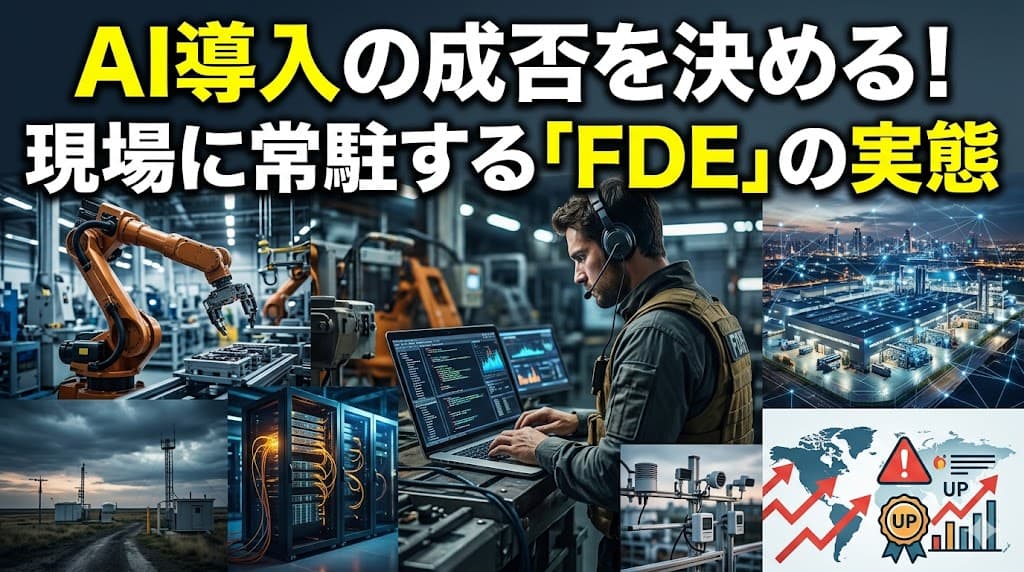
FDE (Forward Deployed Engineer): The On-Site Engineer Role Driving Successful AI Implementation
AI導入の現場で注目される新職種「FDE」をテーマに、社内メモを読み解きながら実装力・定着率を語る実践的なビジネス英語を学べる教材です。
Part 1: 読む → 要約する
Step 1: Pre-Reading — ビジネスの文脈で考える (3 min)
あなたは日系企業のIT部門に所属しています。来週、海外本社から来日するチームメンバーとの会議で、「なぜ自社のAIプロジェクトが現場で定着しないのか」というテーマを議論することになりました。事前に英語で自分の考えを整理しておく必要があります。
Q1: In your company, what is the biggest challenge when introducing new AI tools to actual work sites? 自社でAIツールを現場に導入する際の最大の課題は何ですか。
Q2: Have you ever seen a system or tool that was developed but rarely used by employees? What do you think was the reason? 開発されたものの、現場でほとんど使われなかったシステムやツールを見たことがありますか。その理由は何だと思いますか。
Q3: What kind of engineer or specialist do you think is needed to close the gap between AI development and real business operations? AI開発と実際の業務の間のギャップを埋めるには、どのようなエンジニアや専門家が必要だと思いますか。
Step 2: First Reading — 全体を把握する (10 min)
以下の英文は、ニュース記事の事実をもとに作成したビジネスシナリオ文書です。実際の職場でこのような文書を読む場面を想像しながら、英文を読み進めましょう。
INTERNAL BRIEFING MEMO
To: Members of the AI Transformation Steering Committee From: Digital Strategy Office, Enterprise IT Division Date: March 16, 2026 Subject: Proposal to Adopt the Forward Deployed Engineer (FDE) Model — Decision Required by March 31
1. Background
Over the past 18 months, our company has launched several AI pilot projects across manufacturing, logistics, and customer service divisions. While the technical accuracy of our models has met or exceeded targets, post-deployment surveys indicate that fewer than 40% of end-users continue to rely on these tools after three months. This is a familiar pattern across the industry, and SoftBank Corp. addressed exactly this challenge in a business blog article published on March 13, 2026.
2. Key Concept: Forward Deployed Engineer (FDE)
An FDE is embedded directly within the operational environment of the client — whether that means a production floor, a distribution warehouse, or a customer-facing branch — and works alongside the people who actually use the system. The role goes beyond conventional software development. Rather than receiving requirements through formal documents, FDEs observe daily operations, build working software in short cycles, and refine it through direct conversation with the staff in front of them.
3. Why This Matters for Us
The SoftBank article highlights several recurring failure modes in enterprise AI deployment. Mapping these against our own pilot results, two issues stand out as most urgent for our context:
- The adoption gap. Our internal survey data (under 40% three-month retention) aligns with the article's central observation: technical performance and actual workplace use are different metrics. Closing this gap requires someone empowered to make small fixes immediately rather than queueing them for the next release cycle.
- Compression of the request-to-fix cycle. The article argues that on-site engineers can dramatically shorten iteration time. For our manufacturing pilots, where line supervisors currently wait an average of three weeks for adjustments, this would be transformative.
(A third theme in the article — the quality of source data feeding into AI models — also warrants discussion, but is addressed separately in Appendix A.)
4. Required Capabilities
Drawing on the article's framework, the role demands a combination that is uncommon in our current engineering staff: someone who can ship working code, but who is equally comfortable spending half their time in operational conversations with non-technical staff. The article frames this as a balance between technical breadth, domain curiosity, and tolerance for ambiguity — we would want to assess all three during candidate selection.
5. Action Items
- Each business unit head: nominate one candidate for an internal FDE pilot by March 25
- HR and Training: prepare a reskilling roadmap by April 10
- Finance: review budget reallocation from traditional vendor contracts to FDE staffing
Please review and respond with comments before the steering committee meeting on March 31.
Data sourced from: SoftBank Corp. Business Blog — "FDE(Forward Deployed Engineer)とは? AI導入を成功に導く現場主導型エンジニアの役割" (March 13, 2026)
Note: The above is an original business scenario created for learning purposes using publicly available facts. Please read the original article at the link above for the full report.
関連: IT・エンジニアの英語発音矯正|国際チームで信頼される技術者の話し方 で詳しく解説しています。
Step 3: Comprehension Check — 内容確認 (5 min)
Q1: According to the memo, what percentage of end-users continue to rely on AI tools after three months? メモによると、3か月後もAIツールを使い続けているエンドユーザーは何パーセントですか。
Q2: Where does an FDE typically work, according to the memo? メモによると、FDEは通常どこで働きますか。
Q3: What are the two issues that the memo identifies as the most urgent for the company's context? メモが自社にとって最も緊急性の高いとしている2つの課題は何ですか。
Q4: What three qualities does the SoftBank article suggest should be assessed during FDE candidate selection? ソフトバンクの記事は、FDEの候補者選定で評価すべき3つの素養を何だと述べていますか。
Q5: What is the deadline for business unit heads to nominate a candidate for the internal FDE pilot? 各部門長がFDE社内パイロットの候補者を推薦する期限はいつですか。
関連: AI時代のビジネス英語実践|日本人ビジネスパーソンはAIと英語をどう使うべきか で詳しく解説しています。
Step 4: 30-Second Briefing — 上司に30秒で説明する (10 min)
エレベーターで上司に「あのFDEに関するメモ、読んだ?要点だけ30秒で教えて」と聞かれました。慌てずに、構造的に答えましょう。
| 構成要素 | 英語テンプレート | 内容のヒント |
|---|---|---|
| Topic(話題) | "The memo proposes adopting the _____ model for our AI projects." | FDE(Forward Deployed Engineer)モデル |
| Problem(課題) | "Currently, less than _____ % of users keep using our AI tools after three months." | 40% |
| Solution(解決策) | "An FDE works directly _____ and refines the system through _____ with real users." | 現場で/対話 |
| Benefit(利点) | "This should close the _____ gap and shorten our current _____-week fix cycle." | 定着/3週間 |
| Next Step(次の行動) | "Each unit head needs to nominate one candidate by _____." | 3月25日 |
Tip: 元の英文をそのまま暗記するのではなく、自分の言葉で言い換える(paraphrase する)ことを意識しましょう。例えば "embedded directly within the operational environment" を "works at the actual work site" のように、シンプルな表現に変えるだけで、より自然に話せるようになります。
Part 2: 語彙・表現・発音
1. deploy (v.) — 配置する、展開する
- Example: Our company plans to deploy three engineers on-site at the client's factory next month.
- 訳: 当社は来月、クライアントの工場に3名のエンジニアを現場配置する予定です。
- 外資系シーン: プロジェクトのリソース配分やチーム編成の会議で頻出します。"We need to deploy more resources to this region." のように使われます。
2. implementation (n.) — 実装、導入、実行
- Example: The strategy looks good on paper, but implementation will be the real challenge.
- 訳: その戦略は紙の上では良く見えますが、実装こそが本当の課題になります。
- 外資系シーン: 経営戦略会議やプロジェクトレビューで非常によく使われる単語です。"design phase" と "implementation phase" を区別して話すことが多いです。
3. bottleneck (n.) — ボトルネック、業務の停滞箇所
- Example: Data approval from the legal team has become a bottleneck in our AI rollout.
- 訳: 法務チームからのデータ承認が、AI展開のボトルネックになっています。
- 外資系シーン: プロセス改善や業務効率化の議論で必須の単語です。"What's the biggest bottleneck right now?" は会議の定番質問です。
4. prototype (n./v.) — 試作品、試作する
- Example: Instead of writing a long specification, let's prototype it this week and get feedback.
- 訳: 長い仕様書を書くより、今週試作品を作ってフィードバックをもらいましょう。
- 外資系シーン: アジャイル開発やデザイン思考の現場で頻繁に登場します。"Let's build a quick prototype" は前向きな提案として好まれます。
5. adoption (n.) — 採用、普及、定着
- Example: User adoption of the new system has been slower than we expected.
- 訳: 新システムのユーザー定着は、想定より遅れています。
- 外資系シーン: SaaSビジネスやDX推進の議論で重要なKPI関連語です。"adoption rate"(採用率・利用率)という形でよく使われます。
Fill-in-the-blank Exercise
次の英文の空欄に、上の語彙から最適な単語を選んで入れてみましょう。
Q1: The technical team finished the model, but real-world _______ is taking much longer than planned.
Q2: We need to identify the main _______ in our supply chain before adding new AI tools.
Q3: Our consulting firm plans to _______ a senior engineer at the client's site for six months.
Q4: Low user _______ is often caused by poor user interface design, not weak technology.
Part 3: 自分の意見を述べる
Discussion Topic A
Question: Do you think your company would benefit from having a Forward Deployed Engineer model? Why or why not? 自社にとってFDEモデルは有益だと思いますか。その理由は?
Discussion Topic B
Question: In your opinion, which is more important for a successful AI project: technical skills or business domain knowledge? AIプロジェクトの成功には、技術力と業務知識のどちらがより重要だと思いますか。
Discussion Topic C
Question: How can a company encourage engineers to spend more time at the actual work site rather than in the office? 企業はどうすれば、エンジニアにオフィスではなく現場で多くの時間を過ごすよう促せるでしょうか。
Useful Phrases
| English | Japanese |
|---|---|
| In my experience, the biggest challenge is... | 私の経験では、最大の課題は…です |
| I'd argue that domain knowledge matters more than... | 業務知識は…よりも重要だと主張したいです |
| One concrete example would be... | 具体的な例を1つ挙げると…です |
| That said, we also need to consider... | とはいえ、…も考慮する必要があります |
| From a business perspective, the key is... | ビジネスの観点から見ると、重要なのは…です |
Part 4: 面接対策 — 外資系で差をつける
Mock Interview Scenario A
Interviewer: "Tell me about a time when a technical project you were involved in failed to gain user adoption. What did you learn from it?" 技術プロジェクトでユーザー定着がうまくいかなかった経験を教えてください。そこから何を学びましたか。
Mock Interview Scenario B
Interviewer: "If you were assigned as a Forward Deployed Engineer at a manufacturing client, what would you do in your first two weeks on-site?" あなたが製造業のクライアント先にFDEとして配属されたら、最初の2週間で何をしますか。
Mock Interview Scenario C
Interviewer: "How do you handle a situation where the project requirements change every week?" プロジェクトの要件が毎週変わるような状況に、あなたはどう対応しますか。
Common Mistakes (NG Patterns)
NG 1: 抽象的すぎる回答
- ❌ Bad: "I always try my best and work hard with my team."
- ✅ Good: "In my last project, I held weekly 30-minute sessions with end-users, which increased adoption from 25% to 70% in two months."
- 解説: 外資系の面接では「具体的な数字とアクション」を求められます。抽象的な姿勢の話ではなく、「何をして、どう変わったか」を語ることが評価につながります。
NG 2: 受動的な表現の多用
- ❌ Bad: "I was told to fix the system, so I did what I was asked."
- ✅ Good: "I identified three usability issues and proposed redesigning the input screen, which the team adopted."
- 解説: "I was told..." のような受動表現は、主体性のなさを印象づけます。"I identified..." "I proposed..." といった能動的な動詞で、自分の意思決定を伝えましょう。
NG 3: 失敗を隠そうとする
- ❌ Bad: "All my projects have been successful."
- ✅ Good: "One project didn't meet its initial KPI, but we learned that our data collection process was flawed, and we redesigned it for the next phase."
- 解説: 完璧をアピールするより、「失敗から何を学び、どう次に活かしたか」を語る方が信頼されます。FDEの本質である「仮説検証と改善」の姿勢を示せます。
NG 4: 技術用語の羅列
- ❌ Bad: "I used Python, TensorFlow, AWS, Kubernetes, and Docker to deploy the model."
- ✅ Good: "I built a demand forecasting tool that reduced inventory costs by 15% for the client, using cloud-based machine learning."
- 解説: ツール名の列挙は技術者同士なら通じますが、ビジネス面接では「それで何が変わったか」を伝えることが重要です。技術はあくまで手段、成果が目的です。
活用のコツ(3 Tips)
Tip 1: 自社の「使われないシステム」を1つ思い浮かべて分析してみる 記事のFDE概念を自社の課題に当てはめると理解が深まります。導入されたものの定着しなかったシステムを1つ選び、「現場の声が反映されなかった点」「改善サイクルの遅さ」「データ品質の問題」のどれが主因だったかを考えてみましょう。
Tip 2: 海外メンバーとの会議で「実装段階の課題」を共通言語にする "implementation gap" や "user adoption" は、グローバルチームで議論する際の共通キーワードです。次回の会議で意識的にこれらの表現を使うことで、課題認識を素早く共有でき、議論の質が上がります。
Tip 3: 自分の役割を「FDE的視点」で言語化してみる 自分が現職で「現場に近い立場」「実装に責任を持つ立場」のどちらに近いかを英語で説明できると、外資系の面接や社内異動の場面で強みになります。"I act as a bridge between..." の構文を使って、自分の役割を50秒で説明する練習をしてみましょう。
Bonus: プロナビレッスンでの活用法
レッスン前(20分)
教材のPart 1(Step 1〜3)を自習として読み進めましょう。Step 1の質問は、回答を完璧に英語で書く必要はありません。日本語でメモしておき、レッスン中に英語で口頭発表できるよう準備してください。Step 2のビジネスシナリオ文書は、わからない単語があってもまず最後まで読み通し、全体の流れをつかむことを優先します。Step 3の内容確認問題は、英文中の根拠箇所に下線を引きながら答えると、レッスン中の議論で根拠を示しやすくなります。
レッスン中(25分)
最初の5分でStep 4の30秒ブリーフィングをコーチに対して実演します。フレームワーク表を見ながらでも構いません。次の10分でPart 3のDiscussion Topicから1つを選び、コーチと意見交換を行います。「自分の業界・自社」に引きつけて話すことで、実務に直結する英語力が鍛えられます。残りの10分はPart 4の面接シナリオを1つ選び、模擬面接形式で練習します。NG Patternsを意識して、より具体的な回答を目指しましょう。
レッスン後(15分)
レッスン中にコーチから指摘された表現や、自分が言えなかった表現を5つ書き出し、Part 2の語彙と合わせて自分の単語帳に追加します。翌日までに、Part 3のDiscussion Topicのうちレッスンで扱わなかった1つについて、150語程度で英作文を書いてみましょう。FDEに関する内容を踏まえ、自社の現状や改善案を盛り込めると、単なる英語学習を超えてキャリア構築にもつながります。無料コンサルテーションをご希望の方は、お気軽にお問い合わせください。
参考・出典
この記事を書いた人
サイト運営・日本語サポート担当 / AIエンジニア
- ●東京都出身・海外在住13年以上
- ●IT歴36年以上(開発・SEO・AI)
- ●IBM認定 生成AIエンジニア
- ●CEFR B1の英語学習者(今も学習中)
外資系の現場で「英語が話せず評価が伸びない」苦しさを経験し、海外移住後も印刷所で「copy」が通じないような発音の壁に何度もぶつかってきました。今もプロ講師の指導を受けながら学習を続ける一人として、AI時代でも英語で悩む日本人ビジネスパーソンに向けて、現場目線で記事を書いています。日本語でのご相談やお問い合わせも私が担当します。
関連記事

GMO在宅勤務「完全廃止」を英語で説明する|ニュースで学ぶビジネス英語教材
GMOの在宅勤務「完全廃止」ニュースを教材化。英文社内メモの読解、上司への30秒説明、頻出語彙、面接想定問答まで収録し、働き方トレンドを語れるビジネス英語力を鍛えます。無料の英語学習教材です。
2026/7/14

三菱UFJが時価総額首位に|40年ぶりの「金融復権」を英語で語るビジネス英語教材
三菱UFJが時価総額首位、1986年以来40年ぶりの金融復権。このニュースを教材に、市場・金利・株主還元を語るビジネス英語を学習。社内メモ読解、30秒要約、ディスカッション、外資系面接対策まで実践形式で身につく無料教材です。
2026/7/13

Apple対OpenAI訴訟で学ぶビジネス英語|営業秘密と情報管理を英語で語る実践教材
AppleによるOpenAI提訴のニュースを教材化。営業秘密・情報管理をテーマに、社内メモの読解、上司への30秒説明、重要単語、ディスカッション、面接対策まで実践的に学べるビジネス英語学習コンテンツ。外資系で働く日本人ビジネスパーソンの英語力を鍛えます。
2026/7/12
三菱自動車×東大発Highlandersのヒト型ロボット量産提携で学ぶビジネス英語教材
三菱自動車と東大発Highlandersのヒト型ロボット量産提携ニュースで学ぶビジネス英語教材。mass productionなど頻出語彙、30秒ブリーフィング、外資系面接対策まで実践的に学べる英語学習コンテンツです。
2026/7/11

OpenAI「ChatGPT Work」で学ぶビジネス英語|AIエージェント最新ニュース教材
OpenAIの「ChatGPT Work」とGPT-5.6を題材にしたビジネス英語学習教材。社内メモ読解や30秒ブリーフィング、面接対策を通じて、AI時代の職場で使える実践英語を身につけます。
2026/7/10
Grok 4.5で学ぶビジネス英語|AI最新ニュースで鍛える読解と要約力
話題のAIモデル「Grok 4.5」の英語ニュースを教材化。社内ブリーフィングメモの読解、要約、面接対策まで。最新テックニュースで実践的なビジネス英語を学びたい方へ。
2026/7/9