
消費税減税とPOS改修で学ぶビジネス英語|外資系小売の実務英語教材
消費税減税とPOSシステム改修のニュースで学ぶビジネス英語教材。外資系小売の内部メモ形式で、経産省調査や東芝テック等の事例を題材に実務英語を習得できます。


AIエンジニア / IT歴36年以上・海外在住13年以上のCEFR B1英語学習者
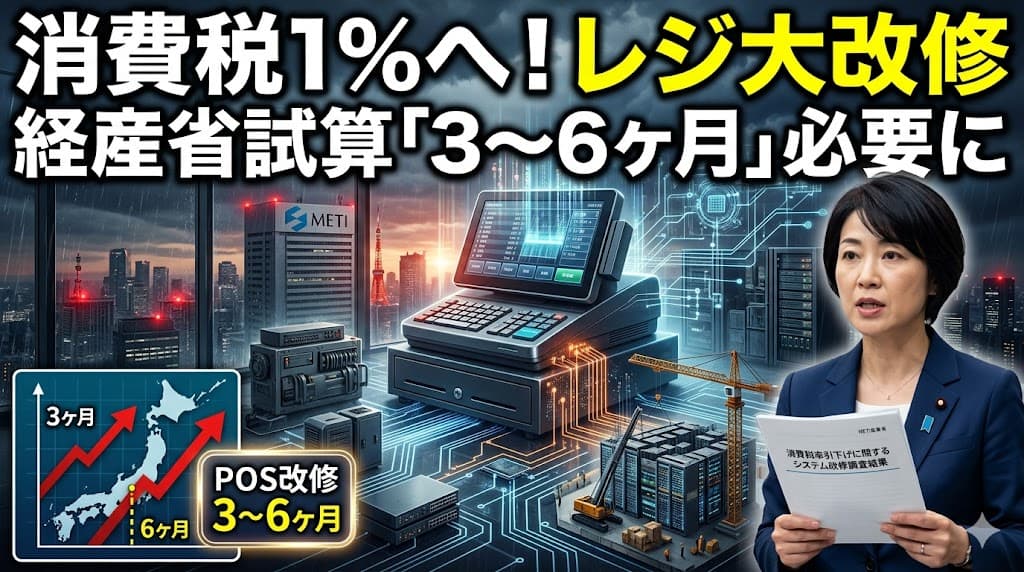
Consumption Tax Cut to 1%: POS System Overhaul Would Take 3–6 Months, METI Finds
日本の食料品消費税1%案とレジシステム改修のニュースを題材に、外資系で使えるビジネス英語と実務語彙を実践的に習得できます。
Part 1: 読む → 要約する
Step 1: Pre-Reading — ビジネスの文脈で考える (3 min)
あなたは外資系小売企業の日本法人で働いています。本社の戦略会議で、日本政府が検討している食料品消費税の引き下げについて、現場オペレーションへの影響を説明するよう求められました。特に、POSシステム改修にかかる時間とコストが議題の中心になりそうです。
Q1: If the Japanese government suddenly changed the consumption tax rate, what operational challenges would your company face first? (自社のオペレーションで、最初に直面する課題を3つ挙げてみましょう)
Q2: Why do you think modifying a POS (point-of-sale) system takes several months, even for a small tax rate change? (単純な数字の書き換えではないという点に注目してみましょう)
Q3: How would you prioritize stakeholders — customers, shareholders, or employees — when communicating about a sudden tax policy change? (ステークホルダーごとに異なる関心事を整理してみましょう)
Step 2: First Reading — 全体を把握する (10 min)
以下の英文は、ニュース記事の事実をもとに作成したビジネスシナリオ文書です。実際の職場でこのような文書を読む場面を想像しながら、英文を読み進めましょう。
INTERNAL BRIEFING MEMO
To: Regional Operations Leadership, APAC From: Tanaka Hiroshi, Director of Japan Retail Strategy Date: April 24, 2026 Subject: Japan Consumption Tax Reduction — POS System Impact Assessment & Action Required
Executive Summary
This memo outlines the operational implications of a potential consumption tax reduction in Japan, based on findings shared at today's Social Security National Council working-level meeting. Leadership should begin contingency planning immediately, as timelines for system modification are significantly shorter than previously assumed.
Key Findings
The Ministry of Economy, Trade and Industry (METI) conducted interviews with three major POS vendors — Toshiba Tec, NEC, and Fujitsu — on April 8. The purpose was to assess how long retailers would need to modify their register systems if the government reduced the consumption tax on food items. According to reporting from today's session, two of the largest vendors estimated that lowering the tax rate to 1% would require approximately five to six months of system modification work. One vendor indicated that a three-month timeline might be feasible at the 1% rate.
These figures represent a meaningful shift from earlier guidance. At a previous meeting, vendors had stated that reducing the food tax rate to zero percent would take roughly twelve months. The revised estimates for a 1% scenario suggest that political negotiators may be converging on this figure as a practical compromise.
Political Context
Toshimitsu Onodera, Chairman of the Liberal Democratic Party Tax Commission, shared these findings with reporters after the meeting. At the same session, four economists were invited to provide expert testimony. Two of them — both prominent reflationists aligned with the Prime Minister's economic thinking — supported the proposed tax reduction.
Recommended Actions
- The Japan IT team should confirm with our vendor whether our current POS infrastructure can accommodate a 1% rate change within a five-month window.
- The Finance team should model revenue impact scenarios assuming implementation between Q3 2026 and Q1 2027.
- Store Operations should draft internal communication templates for frontline staff, pending further political developments.
Please share comments by May 8. A cross-functional alignment call will be scheduled the following week.
Data sourced from: Nikkei — "消費税率1%ならレジ改修3〜6カ月 経産省が大手ベンダー調査" (April 24, 2026)
Note: The above is an original business scenario created for learning purposes using publicly available facts. Please read the original article at the link above for the full report.
関連: AI時代のビジネス英語実践|日本人ビジネスパーソンはAIと英語をどう使うべきか で詳しく解説しています。
Step 3: Comprehension Check — 内容確認 (5 min)
Q1: Which three POS vendors did METI interview regarding the tax rate change? (3社の企業名を正確に答えましょう)
Q2: How long would it take to modify POS systems if the tax rate on food were reduced to 1%? (2社の見解と1社の見解を区別して答えましょう)
Q3: How does the timeline for a 1% reduction compare to the timeline for a 0% reduction? (以前の見積もりと今回の見積もりを比較しましょう)
Q4: Who shared these findings with reporters, and what is his role? (役職名も含めて答えましょう)
Q5: What three action items does the memo recommend? (部署ごとに整理して答えましょう)
Step 4: 30-Second Briefing — 上司に30秒で説明する (10 min)
月曜の朝、オフィスのエレベーターで海外本社から来日した上司とばったり会いました。「昨日のメモ、読んだよ。要点だけ30秒で教えてくれる?」と聞かれました。
| 構成要素 | テンプレート | 自分の言葉で |
|---|---|---|
| 結論 | Japan may reduce the food consumption tax to ___, which would require POS system changes taking ___. | |
| 背景 | METI interviewed three major vendors — ___, ___, and ___ — to assess feasibility. | |
| 重要な数字 | Two vendors estimated ___ months, while one suggested as little as ___ months. | |
| 含意 | This is significantly ___ than the earlier ___-month estimate for a 0% rate. | |
| 次のアクション | Our Japan IT and Finance teams need to ___ by ___. |
💡 Tip: そのまま読み上げるのではなく、自分の言葉に言い換える練習をしましょう。例えば "significantly shorter" を "much faster than before" と言い換えるなど、同じ意味を別の表現で伝える柔軟性が重要です。
Part 2: 語彙・表現・発音
1. assessment (n.) — 評価・査定
- Example: The impact assessment showed that a 1% tax cut would affect our quarterly revenue by approximately 3%.
- 訳: 影響評価によると、1%の減税は四半期の売上に約3%の影響を与えることがわかりました。
- 外資系シーン: プロジェクト開始前のリスク評価会議や、本社へのレポート提出時に頻出する単語です。"risk assessment" "needs assessment" という複合語も一緒に覚えましょう。
2. feasible (adj.) — 実現可能な
- Example: One vendor indicated that a three-month implementation timeline would be feasible under the 1% scenario.
- 訳: あるベンダーは、1%のシナリオであれば3カ月での実装スケジュールが実現可能だと示しました。
- 外資系シーン: 新規プロジェクトの提案時や、タイトなスケジュールを議論する場面で使われます。"Is this feasible?" は「これ、現実的に可能?」というニュアンスで日常的に使われます。
3. contingency planning (n.) — 危機管理計画・代替案の準備
- Example: Leadership should begin contingency planning immediately in case the tax change is implemented earlier than expected.
- 訳: 税制変更が予想より早く実施される場合に備え、経営陣は直ちに代替案の策定を開始すべきです。
- 外資系シーン: BCP(事業継続計画)やリスクマネジメントの文脈で頻繁に登場します。経営層への報告書では定番表現です。
4. converge on (phr. v.) — ~に収束する・~で意見が一致する
- Example: Political negotiators appear to be converging on a 1% rate as a practical compromise.
- 訳: 政治家たちは実際的な妥協点として1%の税率に収束しつつあるようです。
- 外資系シーン: 意見調整や合意形成のプロセスを説明する際に使える洗練された表現です。"agree on" より客観的で知的な印象を与えます。
5. stakeholder alignment (n.) — 関係者間の合意形成
- Example: A cross-functional alignment call will be scheduled to ensure all stakeholders are on the same page.
- 訳: すべての関係者の認識を揃えるため、部門横断の調整会議を設定します。
- 外資系シーン: プロジェクト管理で最重要の概念の一つ。"get alignment" "drive alignment" のように動詞と組み合わせて使われます。
Fill-in-the-blank Exercise
次の空欄に、上記の語彙から最も適切なものを選んで記入してください(形を変えても構いません)。
Q1: Before launching the new service, we need a thorough risk ________ from the legal team.
Q2: Given our current resources, is it ________ to complete this project by the end of Q2?
Q3: The board members gradually ________ a unified strategy after three hours of discussion.
Q4: Our ________ planning should account for possible supply chain disruptions in Southeast Asia.
(解答例: Q1: assessment / Q2: feasible / Q3: converged on / Q4: contingency)
Part 3: 自分の意見を述べる
Discussion Topic A
Do you think reducing the consumption tax on food is an effective way to help low-income households, or are there better alternatives? (減税vs給付付き税額控除など、政策手段の比較で考えてみましょう)
Discussion Topic B
If you were the IT director of a large retail chain, how would you prepare your company for a sudden tax rate change announced only six months in advance? (優先順位付け、リソース配分、外部ベンダーとの交渉などの視点で)
Discussion Topic C
In your industry, what is the biggest challenge when government policy changes require rapid system modifications? (自分の業界・職種に引き寄せて具体的に語りましょう)
Useful Phrases
| English | Japanese |
|---|---|
| From an operational standpoint, ... | オペレーションの観点から言うと... |
| I see both sides of the argument, but ... | 両方の意見に一理ありますが... |
| The challenge here is balancing A with B. | ここでの課題はAとBのバランスを取ることです。 |
| In my experience, this kind of change tends to ... | 私の経験では、こうした変化は~になりがちです。 |
| That's a fair point, but we also need to consider ... | それは一理ありますが、~も考慮する必要があります。 |
Part 4: 面接対策 — 外資系で差をつける
Scenario A: Consulting Firm Interview
Interviewer: "Imagine you are advising a Japanese retail client facing a sudden consumption tax change. How would you structure your recommendation?"
(フレームワーク思考を示すチャンスです。例えば「短期・中期・長期」や「人・プロセス・システム」の切り口で構造化しましょう)
Scenario B: Tech Company Interview
Interviewer: "Tell me about a time you had to respond to an unexpected regulatory or policy change at work. What did you do?"
(STAR法: Situation, Task, Action, Result の順で具体的に語りましょう)
Scenario C: Financial Services Interview
Interviewer: "How do you think a consumption tax reduction in Japan would affect consumer spending and retail sector margins in the next fiscal year?"
(マクロ経済の理解と業界知識を同時に示せる質問です。数字や仮定を明示しましょう)
Common Mistakes (NG Patterns)
1. 結論を後回しにする
- ❌ NG: "Well, there are many factors to consider. First, we need to look at the history of Japanese tax policy, and then..."
- ✅ OK: "My recommendation would be a phased approach. Let me explain the three phases."
- 外資系面接では結論(PREP法のP)を最初に示すのが鉄則です。背景説明を長く続けると「要点が弱い」と評価されます。
2. 数字や固有名詞を曖昧にする
- ❌ NG: "Some Japanese companies will need several months to update their systems."
- ✅ OK: "Major vendors like Toshiba Tec and NEC estimate five to six months for a 1% rate change."
- 具体性は説得力に直結します。記事で得た数字や企業名を積極的に使いましょう。
3. "I think" を繰り返しすぎる
- ❌ NG: "I think it's important. I think companies should prepare. I think the timeline is tight."
- ✅ OK: "In my view, preparation is critical given the tight timeline."
- 同じフレーズの反復は幼稚に聞こえます。"In my view" "From my perspective" "It seems to me" などバリエーションを持ちましょう。
4. 日本の事情を説明しすぎる
- ❌ NG: "In Japan, we have a very unique culture where companies are very careful and slow to change, so..."
- ✅ OK: "The operational complexity stems from the multi-vendor POS landscape, which requires coordinated rollouts."
- 「日本は特殊」という説明は言い訳に聞こえがちです。ビジネス論理で説明する習慣をつけましょう。
活用のコツ(3 Tips)
1. ニュースを「自分の業界なら」で翻訳する習慣をつけましょう。 この記事は小売業の話ですが、製造業なら在庫管理システム、金融業なら取引システムなど、自分の業界に置き換えて考えることで、実務の引き出しが増えます。
2. 数字は必ず「so what?」まで考えましょう。 「5〜6カ月」という数字を読んだら、「それは自分の部署の何を意味するか?」まで踏み込んで考えることで、本社への報告で即戦力の提案ができるようになります。
3. 政策・規制ニュースは週に1本、英語で要約する練習をしましょう。 外資系では日本の政策動向を本社に説明する機会が頻繁にあります。日本語で理解した内容を英語で3〜5文に要約するトレーニングは、実務で最も使う英語力を鍛えます。
Bonus: プロナビレッスンでの活用法
レッスン前 (20min)
記事を日本語で読み、Step 1のPre-Reading Questionsに自分なりの答えをメモします。次に、Step 2のビジネスシナリオ文書を音読しながら、わからない単語や表現に印をつけましょう。Part 2の語彙を先に確認しておくと、読解がスムーズになります。Step 3の内容確認問題に取り組み、答えられなかった箇所を特定しておきます。
レッスン中 (25min)
コーチと一緒にStep 4の30-Second Briefingを実際に声に出して練習します。最初はテンプレートを使い、次第に自分の言葉で言い換えていきましょう。Part 3のDiscussion Topicsから1つ選び、コーチと意見交換します。発音や文法の修正だけでなく、「もっとビジネスらしい表現」へのリファインを受けることで、実務で使える英語が身につきます。Part 4の面接シナリオも1つロールプレイしてフィードバックをもらいましょう。
レッスン後 (15min)
レッスンで指摘された表現や発音のポイントを復習ノートにまとめます。Step 4の30秒ブリーフィングを録音し、自分の声を聞いて改善点を確認しましょう。最後に、今日学んだ語彙を使って、自分の業界に関する短い英文(3〜5文)を書いてみます。翌週のレッスンで添削してもらうことで、定着率が飛躍的に高まります。
PronuNaviでは、こうしたニュース記事を題材に、あなたの業界や職種に合わせたカスタム英語コーチングを提供しています。実務で使える英語力を本気で伸ばしたい方は、ぜひ無料カウンセリングでご相談ください。
参考・出典
この記事を書いた人
サイト運営・日本語サポート担当 / AIエンジニア
- ●東京都出身・海外在住13年以上
- ●IT歴36年以上(開発・SEO・AI)
- ●IBM認定 生成AIエンジニア
- ●CEFR B1の英語学習者(今も学習中)
外資系の現場で「英語が話せず評価が伸びない」苦しさを経験し、海外移住後も印刷所で「copy」が通じないような発音の壁に何度もぶつかってきました。今もプロ講師の指導を受けながら学習を続ける一人として、AI時代でも英語で悩む日本人ビジネスパーソンに向けて、現場目線で記事を書いています。日本語でのご相談やお問い合わせも私が担当します。
関連記事
GMO在宅勤務「完全廃止」を英語で説明する|ニュースで学ぶビジネス英語教材
GMOの在宅勤務「完全廃止」ニュースを教材化。英文社内メモの読解、上司への30秒説明、頻出語彙、面接想定問答まで収録し、働き方トレンドを語れるビジネス英語力を鍛えます。無料の英語学習教材です。
2026/7/14

三菱UFJが時価総額首位に|40年ぶりの「金融復権」を英語で語るビジネス英語教材
三菱UFJが時価総額首位、1986年以来40年ぶりの金融復権。このニュースを教材に、市場・金利・株主還元を語るビジネス英語を学習。社内メモ読解、30秒要約、ディスカッション、外資系面接対策まで実践形式で身につく無料教材です。
2026/7/13

Apple対OpenAI訴訟で学ぶビジネス英語|営業秘密と情報管理を英語で語る実践教材
AppleによるOpenAI提訴のニュースを教材化。営業秘密・情報管理をテーマに、社内メモの読解、上司への30秒説明、重要単語、ディスカッション、面接対策まで実践的に学べるビジネス英語学習コンテンツ。外資系で働く日本人ビジネスパーソンの英語力を鍛えます。
2026/7/12
三菱自動車×東大発Highlandersのヒト型ロボット量産提携で学ぶビジネス英語教材
三菱自動車と東大発Highlandersのヒト型ロボット量産提携ニュースで学ぶビジネス英語教材。mass productionなど頻出語彙、30秒ブリーフィング、外資系面接対策まで実践的に学べる英語学習コンテンツです。
2026/7/11

OpenAI「ChatGPT Work」で学ぶビジネス英語|AIエージェント最新ニュース教材
OpenAIの「ChatGPT Work」とGPT-5.6を題材にしたビジネス英語学習教材。社内メモ読解や30秒ブリーフィング、面接対策を通じて、AI時代の職場で使える実践英語を身につけます。
2026/7/10
Grok 4.5で学ぶビジネス英語|AI最新ニュースで鍛える読解と要約力
話題のAIモデル「Grok 4.5」の英語ニュースを教材化。社内ブリーフィングメモの読解、要約、面接対策まで。最新テックニュースで実践的なビジネス英語を学びたい方へ。
2026/7/9