
AI時代の組織再設計に学ぶビジネス英語|和泉憲明氏の講演で読む・話す力を鍛える
AI時代の組織再設計をテーマにしたビジネス英語学習教材。和泉憲明氏の講演をもとに、社内メモ読解・30秒要約・ディスカッション・面接対策で実践的な英語力を鍛えます。英語学習に最適。
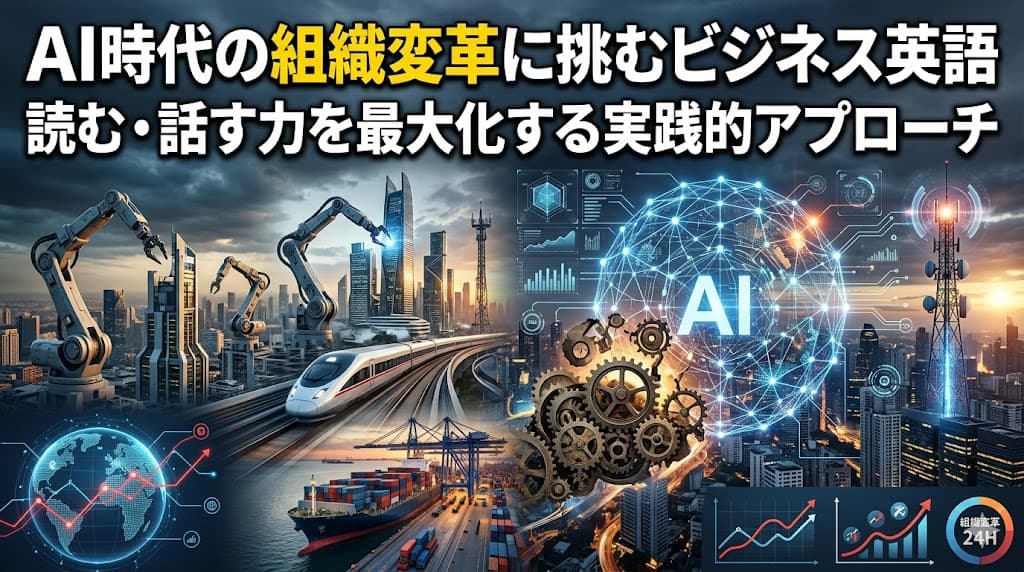
Redesigning the Organization for the AI Era — What Leaders Should Stop Asking Humans to Do
「何を人間にやらせないか」を決めるAI時代の組織論を題材に、社内メモの読解から要約・面接対応まで、実務で使えるビジネス英語を磨きましょう。
経済産業省出身でAIST Solutions Vice CTOを務める和泉憲明氏が語る「AI時代の組織再設計」をテーマに、ビジネス英語を学ぶための教材です。ニュースの事実を素材に、読む・要約する・意見を述べる・面接で話す力を鍛えます。
Part 1: 読む → 要約する
Step 1: Pre-Reading — ビジネスの文脈で考える (3 min)
シーン設定 あなたは外資系企業の日本支社に勤めています。月曜朝のグローバルチームミーティングで、海外の同僚に「日本のAI導入の議論で何が話題になっているか」を共有することになりました。発言の前に、自分の考えを整理しておきましょう。
Q1. In your company, does introducing new software actually make decisions faster, or only faster paperwork? (あなたの会社では、新しいソフトの導入で「意思決定」は速くなりましたか。それとも「事務処理」だけが速くなりましたか。)
Q2. Which tasks in your daily work do you think a human should keep doing, and which could a machine handle? (毎日の仕事のうち、人間が続けるべき作業と、機械に任せられる作業を分けて考えてみましょう。)
Q3. When people say "DX is old, AI is next," do you agree? Why or why not? (「DXはもう古い、次はAIだ」という意見に賛成ですか。理由も考えてみましょう。)
Step 2: First Reading — 全体を把握する (10 min)
以下の英文は、ニュース記事の事実をもとに作成したビジネスシナリオ文書です。実際の職場でこのような文書を読む場面を想像しながら、英文を読み進めましょう。
INTERNAL BRIEFING MEMO
To: Members of the Operations Strategy Committee From: Kenji Sato, Head of Digital Transformation Office Date: June 5, 2026 Subject: Rethinking Our Organization for the AI Era — Discussion Items for the Next Committee Meeting
Purpose This memo summarizes key points raised at the AI Infrastructure Strategy Forum, where Noriaki Izumi, Vice CTO of AIST Solutions and a Senior Expert at Japan's Digital Agency, gave a keynote in March 2026. I am sharing these points so that we can prepare our own position before next week's committee meeting.
Background Mr. Izumi, who previously worked on IT industry policy at the Ministry of Economy, Trade and Industry, made one warning that I believe applies directly to us. When a company only turns paper workflows into digital ones, the speed of information processing goes up, but the speed of decision-making stays the same. In other words, going digital does not automatically make a company faster at deciding things.
He also placed today's changes in a long historical frame. He calls the current shift a "Digital Industrial Revolution" and notes that industrial revolutions tend to follow roughly 100-year cycles. The First Industrial Revolution, which began in the 1750s, used steam power to replace blue-collar physical labor. The current transformation, running from about 1950 to 2050, is instead replacing white-collar office work with AI.
Why This Matters for Us Our department has spent two years digitizing approval flows. We have made our paperwork faster, but our committee still takes the same number of days to reach a final decision. Mr. Izumi's point suggests the problem is not our tools but our design — specifically, who and what we ask to do each task.
Action Items
- Each team leader: list three tasks that humans currently do but a machine could handle. Due June 12.
- Operations: measure how many days our top five decisions actually take. Due June 12.
- All members: come ready to discuss what humans should stop doing, not only what AI should start doing.
Please review these items before the meeting. I welcome your questions in advance.
Best regards, Kenji Sato
Data sourced from: JBpress Innovation Review — "経営者の仕事は「何を人間にやらせないか」を決めること 元経済産業省和泉憲明氏が語るAI時代の組織再設計" (2026.6.4)
Note: The above is an original business scenario created for learning purposes using publicly available facts. Please read the original article at the link above for the full report.
関連: AI時代のビジネス英語実践|日本人ビジネスパーソンはAIと英語をどう使うべきか で詳しく解説しています。
Step 3: Comprehension Check — 内容確認 (5 min)
Q1. According to the memo, what happens when a company only digitizes its paper workflows? (紙のワークフローを電子化しただけのとき、何が起こると述べられていますか。)
Q2. What does Mr. Izumi call the current period of change? (和泉氏は現在の変化を何と呼んでいますか。)
Q3. How long is each industrial revolution cycle said to be? (産業革命のサイクルは、どのくらいの長さだと言われていますか。)
Q4. What did the First Industrial Revolution replace, and what is the current one replacing? (第一次産業革命は何を代替し、現在の変革は何を代替していますか。)
Q5. Why does the writer say the real problem is "design," not "tools"? (筆者が問題は「ツール」ではなく「設計」だと言うのは、なぜですか。)
関連: AIに頼りきりの人とAIを操る人の決定的な差|発音が変えるビジネス英語のキャリア で詳しく解説しています。
Step 4: 30-Second Briefing — 上司に30秒で説明する (10 min)
シーン設定 エレベーターで上司とばったり会いました。「さっきの記事、結局どういう話だったの?」と聞かれます。30秒で要点を伝えてください。
| 要素 | 英語テンプレート | 記入例(埋めてみましょう) |
|---|---|---|
| 結論 | The main point is that ____. | The main point is that going digital alone does not speed up decisions. |
| 背景 | This came from ____, who said ____. | This came from a keynote by Noriaki Izumi, who ____. |
| 重要性 | This matters because ____. | This matters because ____. |
| 次の行動 | So we should ____. | So we should decide what to stop asking humans to do. |
Tip: 記事の文をそのまま暗記せず、自分の言葉で言い換える(paraphrase)練習をしましょう。"replace white-collar work" を "do office tasks instead of people" のように、やさしい表現に置き換えると、本当に理解できているか確認できます。
Part 2: 語彙・表現・発音
1. replace (v.) — 〜に取って代わる、置き換える
- Example: Steam power began to replace human muscle in the 1750s. (蒸気機関は1750年代に人間の筋力に取って代わり始めました。)
- 外資系シーン: プロジェクトで古いシステムを新しいものに切り替える説明をするとき、"We will replace the legacy tool with a cloud service." のように使います。
2. workflow (n.) — 業務の流れ、ワークフロー
- Example: Digitizing a workflow does not always improve how fast we decide. (ワークフローを電子化しても、意思決定の速さが必ず改善するとは限りません。)
- 外資系シーン: 業務改善のミーティングで "Let's map the current workflow first." と言えば、まず現状の流れを可視化しようという提案になります。
3. transformation (n.) — 変革、大きな変化
- Example: The current transformation runs from about 1950 to 2050. (現在の変革は、およそ1950年から2050年まで続きます。)
- 外資系シーン: 経営戦略の話で "digital transformation" や "business transformation" は頻出表現です。単なる "change" より大きな構造変化を指します。
4. decision-making (n.) — 意思決定
- Example: Faster paperwork is not the same as faster decision-making. (事務処理が速いことと、意思決定が速いことは同じではありません。)
- 外資系シーン: 上司への報告で "This will improve our decision-making speed." と言うと、ツールの効果を「意思決定の速さ」という成果で語れます。
5. handle (v.) — (仕事や問題を)扱う、処理する
- Example: A machine could handle the routine tasks instead of people. (機械が、人の代わりに定型作業を処理できるかもしれません。)
- 外資系シーン: 役割分担の会話で "Can your team handle this part?" は「この部分を担当できますか」という自然な確認になります。
Fill-in-the-blank exercise
次の英文の空欄に、上の語彙から最も適切なものを入れましょう(必要に応じて形を変えてください)。
- We need to ____ the old approval system with a faster one.
- The committee is too slow; our ____ takes a week.
- AI is part of a long-term ____ in how offices work.
- Can the support team ____ these requests during the holiday?
解答: 1. replace 2. decision-making 3. transformation 4. handle
Part 3: 自分の意見を述べる
Discussion Topic A
Should leaders focus on deciding what not to ask humans to do? Do you think a leader's main job is choosing which tasks to remove from people? Give one example from your own workplace. (リーダーの主な仕事は「人間にやらせないこと」を決めることだと思いますか。自分の職場の例を一つ挙げて話しましょう。)
Discussion Topic B
Is "digitizing" enough, or does the organization itself need to change? Some companies digitize their paperwork but keep the same slow decision process. What would you change first — the tools or the structure? (書類を電子化するだけで十分ですか。それとも組織そのものを変える必要がありますか。まずツールと構造のどちらを変えるべきか述べましょう。)
Discussion Topic C
Is the 100-year "cycle" view useful for planning today? Mr. Izumi frames today as part of a 1950–2050 shift. Does such a long-term view help managers make real decisions, or is it too abstract? (和泉氏は現在を1950〜2050年の変化の一部と捉えています。このような長期的な視点は実際の経営判断に役立ちますか、それとも抽象的すぎますか。)
Useful phrases
| English | 日本語 |
|---|---|
| From my experience, I'd say that... | 私の経験から言うと、〜だと思います |
| It depends on the situation, but... | 状況によりますが、〜 |
| I see your point, however... | おっしゃることは分かりますが、〜 |
| Let me give you a concrete example. | 具体例を一つ挙げさせてください |
| If I had to choose, I would prioritize... | 選ぶとすれば、〜を優先します |
Part 4: 面接対策 — 外資系で差をつける
Mock Interview A
Interviewer: "Tell me about a time you improved a process at work. What changed, and what stayed the same?" (業務プロセスを改善した経験を教えてください。何が変わり、何が変わらなかったですか。) ヒント: 記事の「処理は速くなったが意思決定は変わらない」という視点を借りて、成果と限界の両方を正直に話すと説得力が増します。
Mock Interview B
Interviewer: "If you led a team during a major technology change, how would you decide which tasks to automate?" (大きな技術変化の中でチームを率いるとき、どの作業を自動化するかをどう決めますか。) ヒント: "First, I would ask what humans should stop doing." のように、判断の順序を示すと論理的に聞こえます。
Mock Interview C
Interviewer: "Why do you think some digital projects fail to deliver real results?" (なぜ一部のデジタルプロジェクトは実際の成果を出せないと思いますか。) ヒント: 「ツールを入れ替えただけで、設計思想を変えていないから」という切り口を、自分の言葉で説明してみましょう。
Common Mistakes — 4 NG Patterns
NG 1: 専門用語を並べるだけ
- ✗ Bad: "We did RPA, LLM, RAG, and DX."
- ◯ Good: "We automated repetitive tasks so the team could focus on decisions." 説明: 略語を並べても中身は伝わりません。何を達成したかを平易な言葉で言うほうが評価されます。
NG 2: 主語があいまい
- ✗ Bad: "The decision was made and the speed was improved."
- ◯ Good: "Our committee made the decision, and it improved our speed." 説明: 受け身ばかりだと「誰がやったか」が消えます。外資系では主体を明確にすると信頼されます。
NG 3: 成果を誇張する
- ✗ Bad: "We completely solved every problem with AI."
- ◯ Good: "AI sped up processing, but decision-making still needs people." 説明: 限界も認めるほうが、誠実で現実的な印象を与えます。
NG 4: 質問に直接答えない
- ✗ Bad: "Well, technology is very important these days, you know..."
- ◯ Good: "To answer directly: I would first decide which tasks to remove." 説明: 前置きが長いと逃げている印象になります。まず結論から述べましょう。
活用のコツ(3 Tips)
まず「やめること」を一つ決めてから、新しいツールを検討しましょう。 記事の核心は「何を人間にやらせないかを決める」ことです。新しいAIツールを足す前に、今週の業務から削れる作業を一つ挙げてみると、組織再設計の第一歩になります。
「処理速度」と「意思決定速度」を分けて測りましょう。 電子化で事務は速くなっても判断が遅いままなら効果は限定的です。主要な意思決定が実際に何日かかっているかを記録すれば、改善すべき本当のボトルネックが見えてきます。
目の前の流行語ではなく、長期の構造変化として捉えましょう。 「DXか、AIか」という言葉の入れ替えに振り回されず、1950〜2050年規模の変化の一部として自社の仕事を見直すと、短期的なツール選びに惑わされにくくなります。
Bonus: プロナビレッスンでの活用法
レッスン前(20min) Part 1のStep 1〜2に取り組み、Pre-Readingの質問に自分の答えをメモしてから、ビジネスメモ英文を音読しておきましょう。Step 3の内容確認も先に解いておくと、レッスン中の議論に集中できます。分からない単語はPart 2で先に確認しておくとスムーズです。
レッスン中(25min) コーチと一緒にStep 4の30秒ブリーフィングを実演し、フィードバックを受けます。続いてPart 3のディスカッションで自分の意見を英語で述べ、言い換え(paraphrase)や論理構成を磨きます。Part 4の模擬面接も、コーチが面接官役となって実践練習します。
レッスン後(15min) レッスンで指摘された言い換えや表現を1〜2文だけ自分の言葉で書き直し、翌日の業務メールやチャットで実際に一度使ってみましょう。「活用のコツ」で挙げた「やめること一つ」を職場で試し、その結果を次回のレッスンで報告すると定着が進みます。
参考・出典
関連記事
【ビジネス英語】日本のビザ厳格化とカレー店閉店で学ぶニュース英語教材
日本のビザ規制厳格化とカレー店閉店のニュースで学ぶビジネス英語教材。社内メモ読解・要約・面接対策まで、外資系で働く日本人向けに実践的な英語学習ができます。
2026/6/6

ヤマダHD・エディオン経営統合で学ぶビジネス英語|M&Aニュース英語学習教材
ヤマダHDとエディオンの経営統合ニュースで学ぶビジネス英語教材。社内メモ読解、要約、語彙、面接対策まで網羅し、M&Aや決算の英語表現を実務で使えるレベルに。英語学習に最適。
2026/6/4

AIコスト上限のニュースで学ぶビジネス英語|ウォルマート・ウーバー事例で読解と要約力UP
米企業のAIコスト上限ニュースを教材化。ウォルマートやウーバーの事例で英文読解・要約・意見表明・面接対策を学ぶビジネス英語学習コンテンツ。外資系で働く社会人向けの実践的英語学習教材です。
2026/6/3
アンソロピック上場申請で学ぶビジネス英語|AI業界ニュースで学ぶ実践教材
アンソロピックの上場申請(IPO)ニュースを教材にビジネス英語を学習。社内メモ読解、要約、ディスカッション、面接対策まで、外資系で通用する実践力を養う英語学習コンテンツです。
2026/6/2
ヒューマノイドロボット量産化のニュースで学ぶビジネス英語|EngineAI「T800」で読む英語教材
量産化したヒューマノイドロボット「T800」のニュースを使ったビジネス英語の学習教材。社内メモ読解・要約・面接対策で、最新トレンドを語れる英語力を身につけます。英語学習に最適。
2026/6/1
英語スピーキング正答率12%の衝撃|ニュースで学ぶビジネス英語教材
英語スピーキング正答率12%のニュースを題材に、ビジネス英語を学ぶ教材。社内メモ読解・要約・ディスカッション・面接対策で「話せる」力を鍛え、外資系で通用する実践力が身につきます。
2026/5/31


AIエンジニア / ITエンジニア歴35年以上 / 海外在住12年以上のCEFR B1英語学習者
外資系の現場で「英語が話せず評価が伸びない」苦しさを体験し、海外移住後も印刷所で「copy」が通じないような発音の壁に何度もぶつかってきました。今もプロ講師の指導を受けながら、AIだけに頼らない英語学習を続けています。同じようにAI時代でも英語で悩む日本人ビジネスパーソンに向けて、現場目線で記事を書いています。